 Korean Stock Insight
KOSPI Falls 3.59% as Ownership, Cybersecurity and Satellite Catalysts Stand Apart
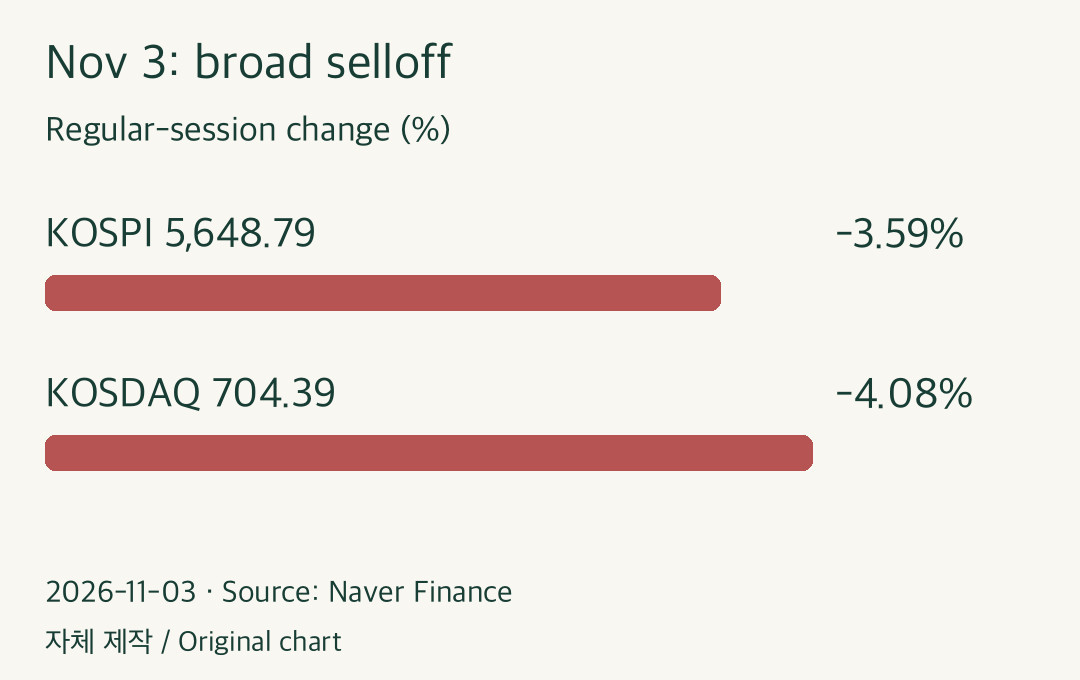
Korea’s rebound failed to carry into November 3. The KOSPI lost 3.59% to 5,648.79 and the KOSDAQ fell 4.08% to 704.39. We see a broadly weak market with selective buying around ownership changes, cybersecurity and satellite equipment. Those pockets deserve attention, but they do not yet amount to a recovery in participation across Korean equities.
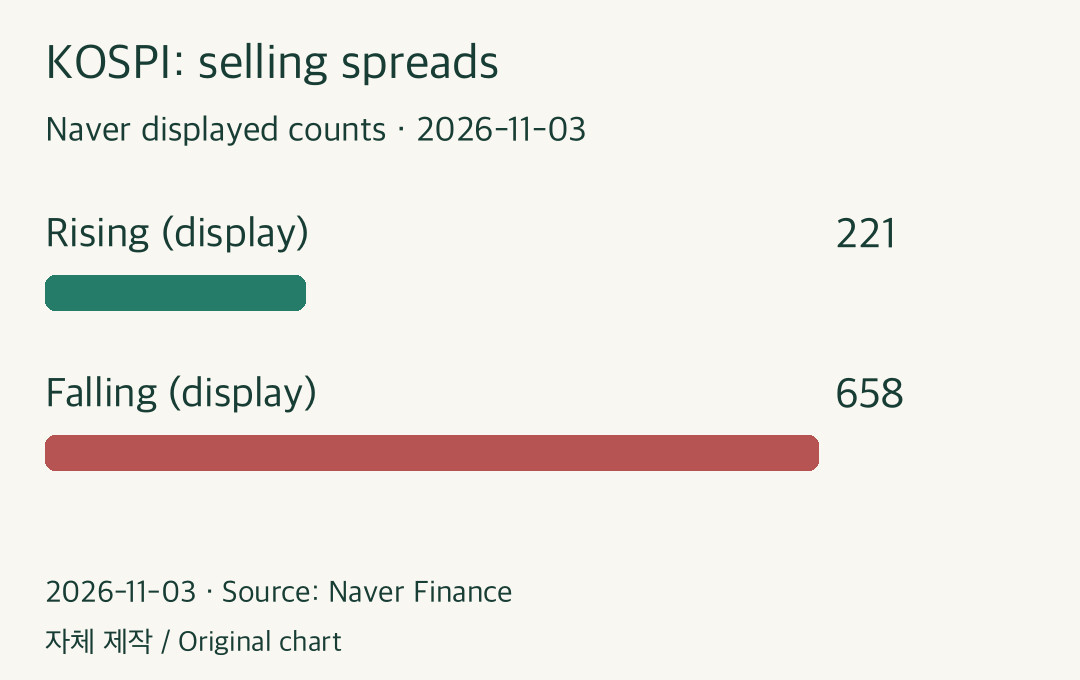
The closing screens make that distinction clear. Naver Finance displayed 221 rising stocks against 658 falling stocks on the KOSPI, and 322 versus 1,350 on the KOSDAQ. The main board opened at 5,715.19 and touched 5,615.80; the KOSDAQ’s opening level of 723.92 was also its session high. Both finished above their lows, but the distribution of gains and losses still favored sellers.
Institutions and foreign investors were net sellers in both markets, with individuals buying. That removed an important source of support from Monday’s recovery. Overnight, the Nasdaq fell 1.07% and the Philadelphia Semiconductor Index lost 3.37%. Yonhap linked the US backdrop to concern over returns on AI investment and caution before the midterm election. Our interpretation is that this uncertainty also weighed on the valuation investors were willing to assign to Korean growth businesses.
For memory leaders such as Samsung Electronics and SK hynix, the practical question is whether customer investment can sustain orders. Larger AI budgets create opportunities, yet financing pressure on customers could change the timing of equipment spending and purchases. We would want to see selling pressure ease and participation return across the chip supply chain before treating a benchmark bounce as a broader improvement.

Hanjin KAL followed a company-specific ownership catalyst. Newsway reported that the shares reached KRW 175,200, up 29.97%, at 11:09 a.m., as potential competition between Hoban Group and Chairman Cho Won-tae for stakes attracted buyers. The relevant driver is demand for shares linked to ownership, rather than a sudden change in airline operating earnings. Further purchases could sustain that demand; a fading contest could remove the premium. Subsequent ownership disclosures matter more than extrapolating the initial price move.
Cybersecurity offered a different route to potential business growth. Newsis reported intraday gains of 29.96% for Hanssak and 18.03% for Genians at 9:40 a.m. amid financial-sector hacking incidents. Security reviews can lead to spending on access controls and data protection, but procurement and deployment take time. We would look for new customers and recurring revenue to assess whether the initial trading response is developing into earnings growth.
AP Satellite had a concrete delivery milestone. In a company announcement reported by Newsis, it supplied an AVTS system for testing and verifying KPS satellite flight modules to the Korea Aerospace Research Institute. Wide Economy reported an intraday gain of more than 22% that morning. The delivery provides experience that may support bids for subsequent projects. The commercial test will be the size, timing and profitability of follow-on orders; a national space program’s overall budget cannot be assigned to an individual supplier.
These catalysts operate through different channels: purchases of stock, customer security budgets and equipment orders. Each can support an individual company without reversing a broad market decline. We prefer to evaluate whether the underlying event advances after the initial price reaction, rather than interpreting every outperformer as evidence that risk appetite has returned.
For November 4, our first checks are lighter foreign and institutional selling and fewer declining stocks. A recovery that spreads across sectors and reaches the chip supply chain would strengthen the case for a more durable turn. If gains remain confined to a handful of event-driven names, we would keep that assessment selective. Ownership purchases, security contracts and further satellite orders are the concrete developments that could change our view of the individual themes.
#KOSPI #KOSDAQ #HanjinKAL #Cybersecurity #Satellite
This article is for informational purposes only and is not a recommendation to buy or sell securities. Investors are responsible for their own decisions.