 Korean Stock Insight
KOSPI Falls 3.48% as Chip Selling Leaves Selective Drug and Security Catalysts
Korea ended October with a broad equity selloff. The KOSPI lost 3.48% to 5,730.74 on October 30, while the KOSDAQ fell 3.83% to 724.38. A rebound from the intraday low did not repair weak participation. Our preference is to assess identifiable company catalysts while watching whether pressure on the large semiconductor names begins to ease.
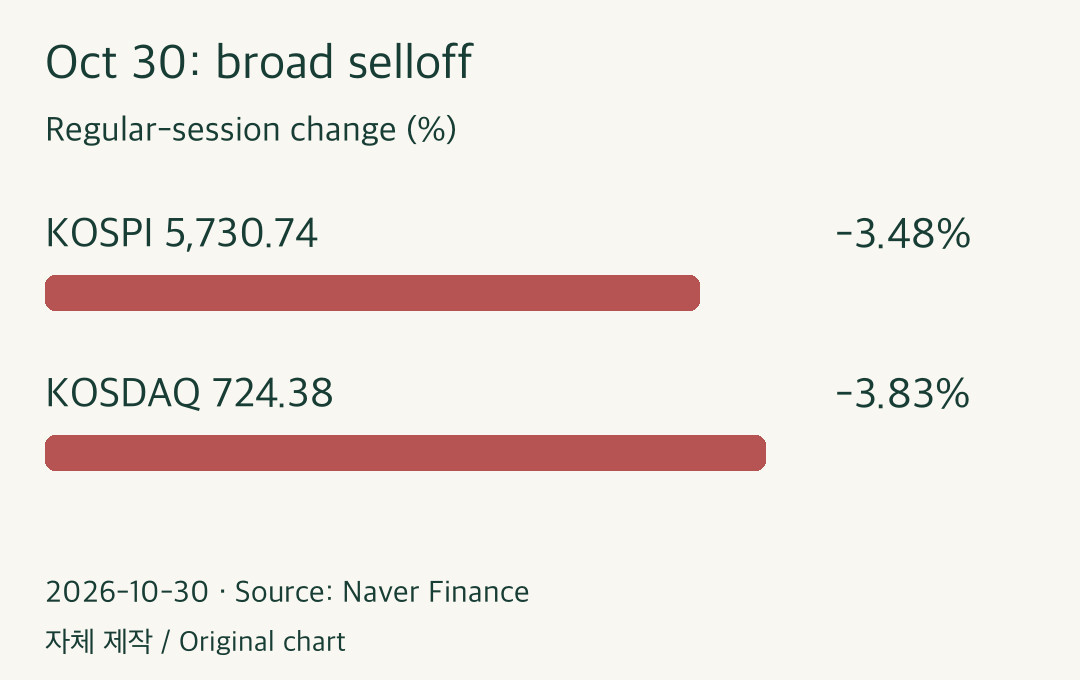
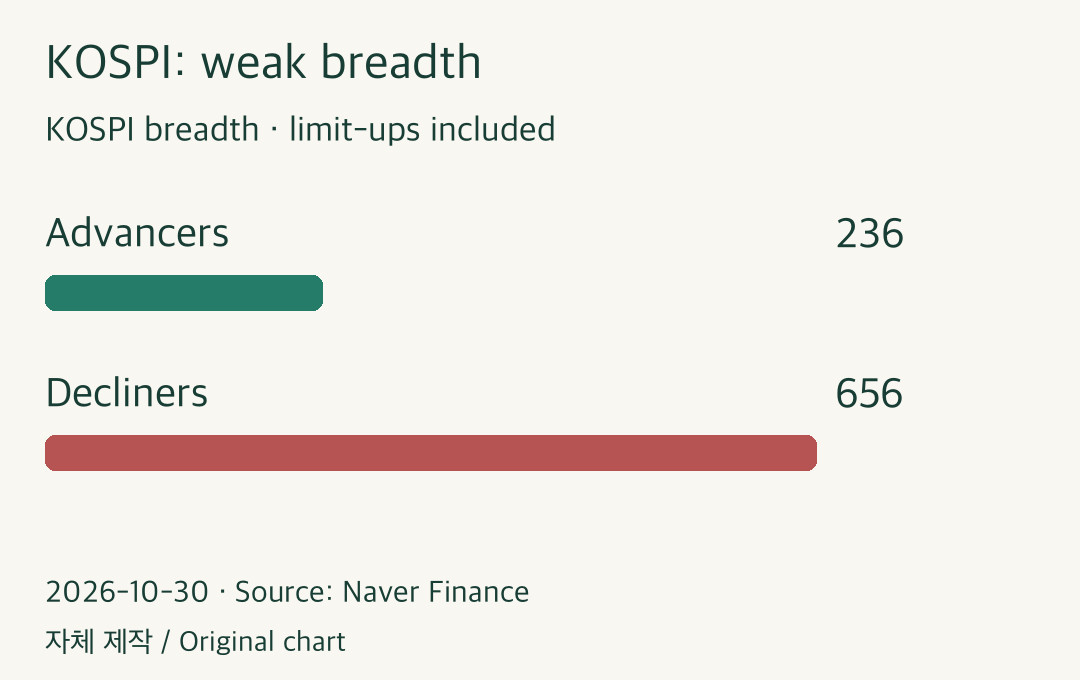
Naver Finance counted 236 advancing main-board stocks, including two limit-up names, against 656 decliners. KOSDAQ had 268 advancers and 1,407 decliners including limit moves. The KOSPI recovered from 5,599.42, but the smaller-company market still had more than five falling stocks for each riser. For international investors, that breadth is a useful counterweight to the more reassuring late recovery in the headline index.
Foreign investors were net sellers of the main board while institutions bought. Both groups sold KOSDAQ. Institutional support in large companies therefore did not establish a broad return of risk appetite. We would look for improving overseas flows and wider participation before treating an index bounce as a reason to expand exposure across the market.
Semiconductors transmitted the weakness in US technology shares into Korea. Yonhap Infomax reported that a sell-side program-trading sidecar was triggered at about 10:04 a.m. At 10:06 a.m. KST, Samsung Electronics and SK Hynix were down 5.17% and 8.72%, respectively. These are intraday observations, not closing returns. The combination illustrates how a lower valuation multiple can overwhelm favorable operating results during a market repricing.

For the semiconductor investment case, customer AI spending still matters through the orders it creates for memory suppliers. Concerns about customers’ returns on that spending can nevertheless reduce the multiple investors are willing to pay. We would place more weight on persistent orders, revisions to profit expectations and easing foreign selling than on the size of a single-day decline.
Drug development offered a separate catalyst. ChosunBiz reported Daewon Pharmaceutical at KRW8,910, up 15.71%, at 9:24 a.m. Its October 29 DART disclosure said a 328-patient phase 3 study of padoprazan demonstrated non-inferiority to the comparator at both the 20mg and 40mg doses. Detailed analysis, a final report and a marketing-approval application are planned. The commercial opportunity depends on regulatory progress and launch execution; the market reaction reflects progress in development before revenue is established.
Cybersecurity shares also attracted selective buying after reports of attacks on Korean financial businesses. ChosunBiz put RaonSecure up 14.29% and Genians up 12.4% at 9:41 a.m. Demand for authentication and access-control reviews could translate into contracts. For valuation, we would distinguish temporary incident-response spending from recurring maintenance revenue and sustained customer relationships.
Our three Focus themes are semiconductor repricing, clinical-development progress and financial-sector cybersecurity demand. The first explains pressure on the benchmark; the others identify company-specific buying within a weak market. For the next session, easing chip selling, clearer regulatory milestones and evidence of security contracts would strengthen the individual cases. Improving KOSDAQ flows and market breadth would be the conditions for broadening the overall view.
#KOSPI #KOSDAQ #Semiconductors #DrugDevelopment #Cybersecurity
This article is for informational purposes and does not recommend buying or selling securities. Investors are responsible for their decisions and outcomes.