 Korean Stock Insight
KOSPI Falls 5.28% as Chips Slide and Autos, Banks and Biopharma Diverge
Korea’s selloff was severe, but it was not uniform. On November 5 the KOSPI lost 300 points, or 5.28%, to 5,383.80, while the KOSDAQ fell 5.11% to 678.41. Hyundai Motor, KB Financial and Celltrion nevertheless advanced. We read the session as a sharp repricing of AI-linked growth accompanied by selective demand for other earnings streams. Those pockets of buying were too narrow to establish a broad market recovery.
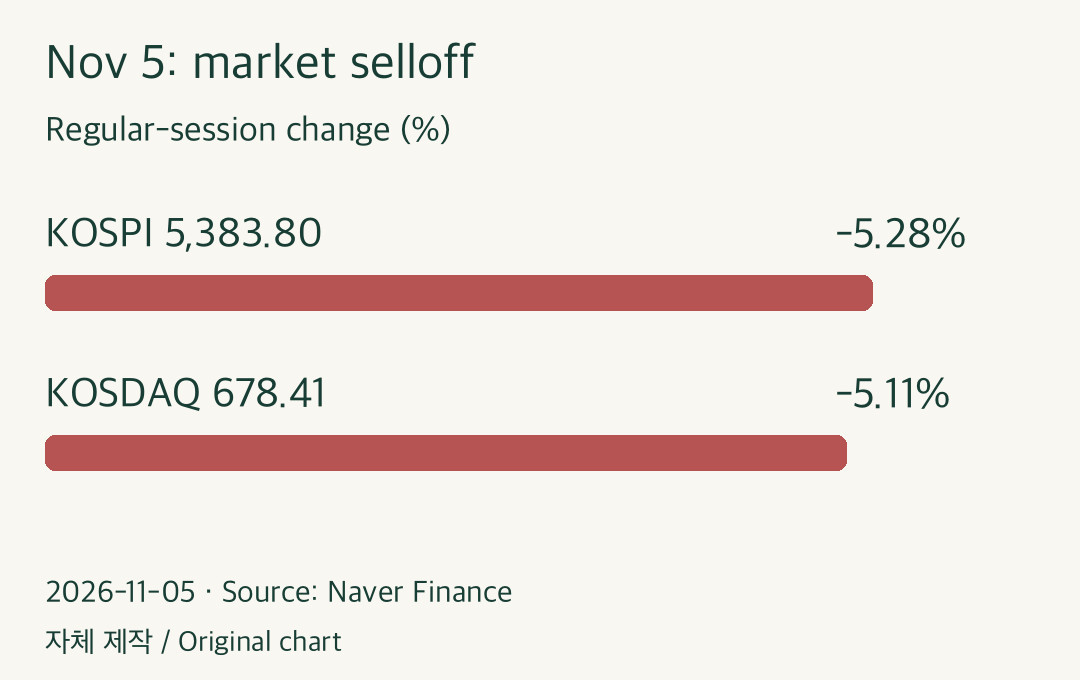
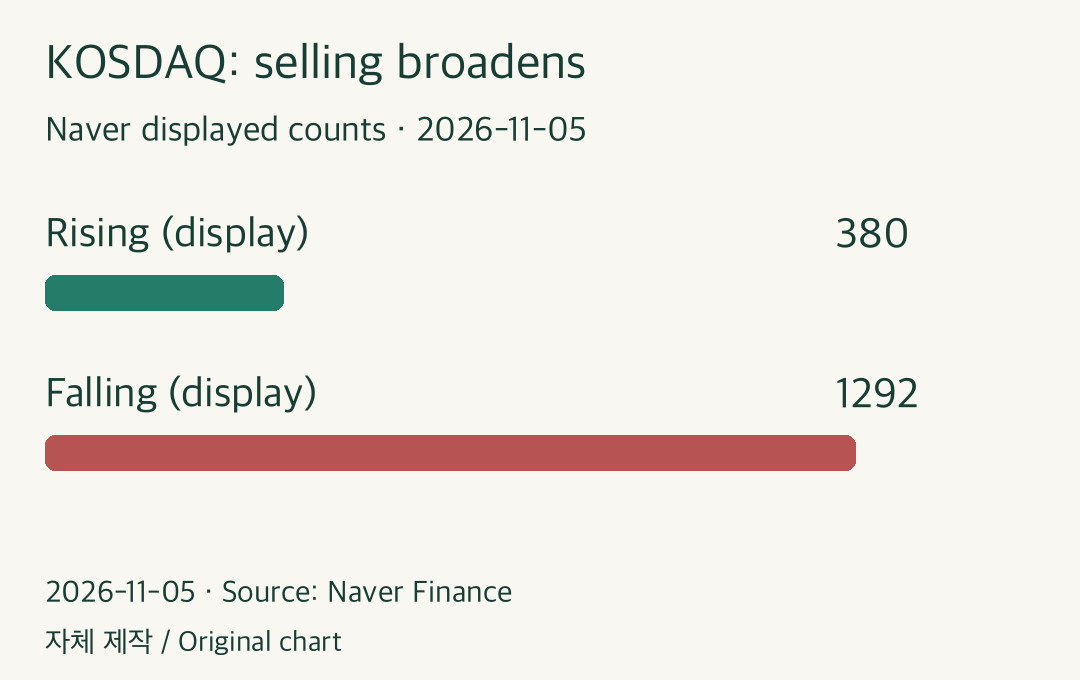
The intraday path reinforces that distinction. The KOSPI opened at 5,580.09, peaked at 5,586.46 and touched 5,336.88 before closing below its opening level. The KOSDAQ opened at 713.49 and reached a low of 673.38. Both benchmarks surrendered the previous session’s rebound. Naver Finance displayed 344 rising stocks versus 537 falling on the main board and 380 versus 1,292 on the KOSDAQ. Selling extended well beyond a handful of index heavyweights.
Foreign investors were net sellers of the KOSPI, with individuals and institutions on the buying side. On the KOSDAQ, both foreigners and institutions sold on a net basis while individuals bought. Sell-side program-trading sidecars were triggered on the main board at 10:16 a.m. and on the KOSDAQ at 2:27 p.m. Institutional buying in large caps therefore coexisted with substantial pressure across the market.
Memory stocks sat at the center of the adjustment: Newsis reported closing losses of 7.57% for Samsung Electronics and 9.46% for SK hynix. Coverage linked weaker sentiment to concerns that US election results could bring tighter data-center permitting and regulation. For suppliers, the important commercial channel is the timing of customer investment. Delayed approvals could push orders and deliveries further out. Market concern about that possibility is not evidence that orders have already been cancelled.

The exposure runs through components and equipment as well. Samsung Electro-Mechanics, Simmtech and EO Technics closed down 15.34%, 17.97% and 16.21%, respectively, according to closing coverage. Slower customer construction could affect revenue timing and utilization throughout this supply chain. We would separate a delivery deferral from a permanent reduction in project scope: they imply different earnings paths. Changes in order books and shipment schedules will be more useful than assuming every sharp price fall signals the same deterioration.
Hyundai Motor gained 3.53% and KB Financial rose 3.63%, highlighting demand for businesses whose earnings are less directly tied to data-center construction. That is a useful diversification signal, though one day’s relative strength does not establish sector-wide earnings upgrades. Vehicle volumes and pricing, and bank net interest income and credit costs, are the operating measures that could give this rotation a longer life.
Celltrion rose 7.50%. The company also announced that launches of Coyvolma, Stoboclo and Osenvelt had expanded its Brazilian portfolio to ten products. Adding therapies to an established distribution network offers a route to prescription growth. We see this as a concrete business development to track alongside the stock move, without assigning it sole responsibility for the rally. Prescription uptake and selling expenses will determine how much incremental revenue reaches profit.
For investors, the distinction is between an intact demand outlook and a customer investment schedule that is changing. A lower share price can remain demanding if earnings expectations fall faster. Conversely, confirmed deliveries against an unchanged order book could support a revaluation after a sentiment-driven selloff. Today’s gains in selected automotive, banking and pharmaceutical names do not resolve that question for the wider market.
On November 6, our first tests are easing foreign selling and fewer declining KOSDAQ stocks. Higher lows in memory shares, coupled with sustained strength in today’s alternative leaders, would make broader participation more credible. A narrow bounce or confirmed customer spending cuts would argue against rushing to increase exposure. We would change that judgment on evidence of wider buying and resilient orders, rather than on the size of a single day’s decline.
#KOSPI #KOSDAQ #Semiconductors #HyundaiMotor #KBFinancial #Celltrion
This article is for informational purposes only and is not a recommendation to buy or sell securities. Investors are responsible for their own decisions.