 Korean Stock Insight
KOSPI Rebounds 2.24% as Chips, Shipbuilders and Grid Equipment Broaden Gains
Korean equities reversed an early selloff on November 2. The KOSPI finished at 5,859.08, up 2.24%, after touching 5,616.50. The KOSDAQ added 1.38% to 734.36. Our reading is that participation improved: chips helped lift the benchmark, while shipbuilding and power equipment gave investors additional places to put money. The remaining test is whether that breadth can survive a less supportive day of institutional buying.
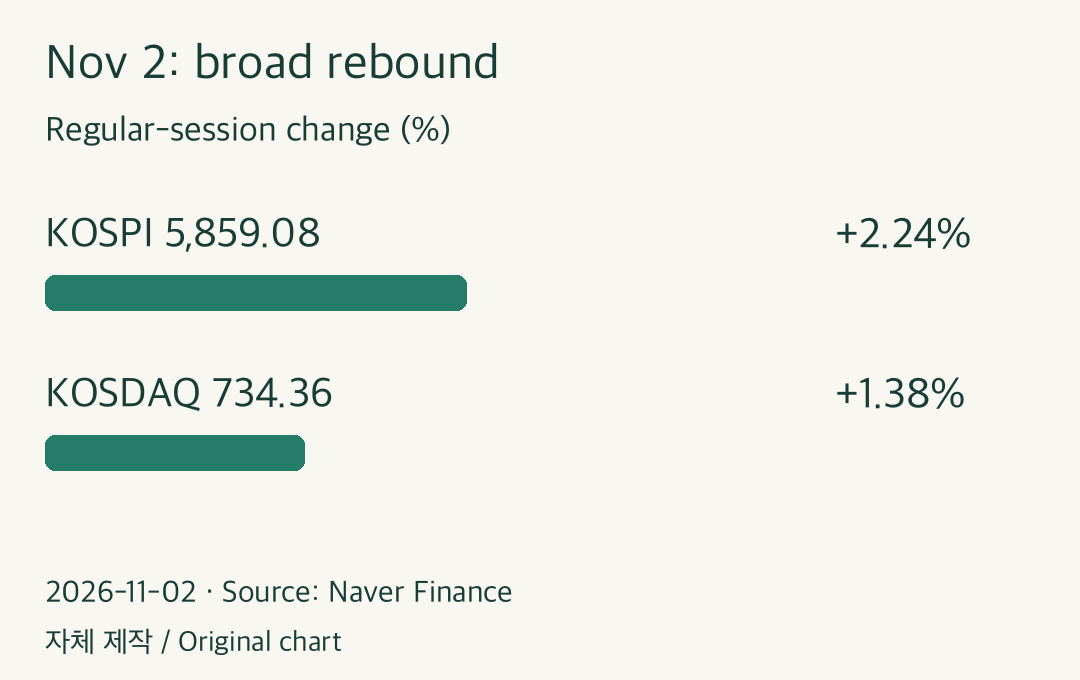
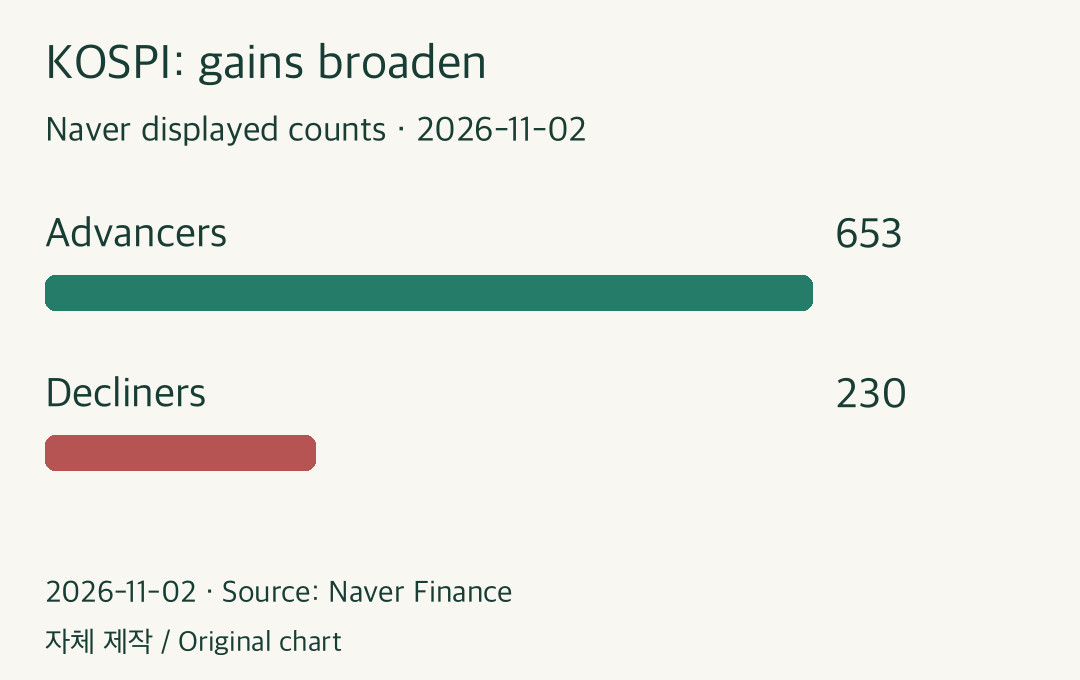
Naver Finance’s closing screens showed more advancing than declining stocks in both markets. The KOSPI screen displayed 653 rising stocks against 230 falling stocks. Asia Economy’s closing report also showed gains across construction, transport and manufacturing, with pharmaceuticals, securities and insurance among the exceptions. This was a broader recovery than a rally carried solely by the largest chip companies.
The identity of the buyers tempers the positive breadth signal. Institutions were net buyers in both markets, while foreign investors and individuals sold. Domestic institutional demand absorbed selling pressure; foreign investors had yet to join the move. For global investors, a subsequent improvement in foreign flows would give the recovery an additional source of support. Without it, the market remains more dependent on institutional demand continuing.
Memory and its supply chain form the first focus. Gukje News reported regular-session closes of KRW 229,000 for Samsung Electronics, up 1.78%, and KRW 1,472,000 for SK hynix, up 3.81%. Substrate maker Simmtech rose 6.08%. That combination suggests buying reached beyond the two heavyweight memory producers. We see the next test in customer spending and shipments: sustained orders would make the move more convincing than a short-lived rebound after Friday’s decline.

Capacity expansion can support revenue growth, but it also commits chipmakers to future depreciation costs. A delay in customer orders can therefore change the earnings picture even when product pricing is firm. We would look for evidence that substrate and equipment demand is following memory investment before extending a positive view across the entire supply chain.
Shipbuilders provided another source of strength. Asia Economy identified Hanwha Ocean, Samsung Heavy Industries and HD Korea Shipbuilding & Offshore Engineering among the day’s gainers. Korea Economic Daily linked the sector’s rebound to reduced valuation pressure after recent declines and the expected revenue contribution from vessels booked at higher prices. Our preference is to follow delivery execution and margins: a large order book becomes more valuable when vessels leave the yard on schedule without an offsetting rise in labor and material costs.
Power equipment is the third focus. Hyosung Heavy Industries and LS ELECTRIC featured among the strong names in the closing report. Hyosung’s third-quarter consolidated revenue was KRW 1.7406 trillion and operating profit KRW 243.5 billion. Newstomato reported a KRW 18.9 trillion order backlog in its heavy-industry division. Yuanta Securities, cited by Edaily, expects delayed revenue to be recognized in the fourth quarter. We regard delivery normalization as the key earnings test; another delay would push the expected recovery further out.
The common thread is the conversion of demand into cash-generating business: chip shipments, higher-priced vessel deliveries and grid-equipment handovers. These businesses need different execution milestones, even when they rise on the same day. We would become more confident in the rebound if foreign selling eases and advancing stocks remain dominant when institutional buying slows. A return to narrow heavyweight leadership would instead favor a more selective approach.
#KOSPI #KOSDAQ #Semiconductors #Shipbuilding #PowerEquipment
This article is for informational purposes only and is not a recommendation to buy or sell securities. Investors are responsible for their own decisions.