 Korean Stock Insight
Korea Stock Market Rally: Is This a Bottom or an Earnings-Season Rebound?
The Korea stock market rally on July 15, 2026 spread far beyond Samsung Electronics and SK Hynix. The KOSPI closed 6.24% higher at 7,284.41, while the KOSDAQ jumped 5.80% to 829.43. Both markets triggered buy-side sidecars as futures-led program buying accelerated. Samsung Electronics gained 6.27% and SK Hynix rose 8.83%, but defense, components and growth stocks also advanced. Three developments calmed the market: softer-than-expected U.S. inflation, IBM’s disclosure about customers shifting spending toward servers, storage and memory, and a sharp rise in SK Hynix’s U.S.-traded ADRs. These signals challenged the idea that AI infrastructure demand had suddenly collapsed, but they did not eliminate earnings risk or prove that a lasting bottom is already in place.
What the Korea stock market rally confirmed
The most encouraging feature was breadth. Foreign investors bought a net 2.34 trillion won of KOSPI shares and institutions added about 183.1 billion won, while retail investors sold roughly 2.46 trillion won. The two memory leaders were central to the recovery, but buying spread across sectors. A rebound driven only by two index heavyweights can disappear quickly when short covering ends. Broader participation suggests that investors were reassessing whether the previous selloff had priced in too much fear.
A buy-side sidecar is not a bullish forecast. It temporarily pauses program purchase orders when futures and cash-market moves become unusually fast. Investors should focus on what comes next: trading value, market breadth, persistent foreign cash-market purchases and whether opening gaps can hold. The Korea stock market rally proved that risk appetite can return rapidly, but follow-through capital is required to turn a one-day rebound into a trend.
Cooler U.S. CPI reduced rate anxiety
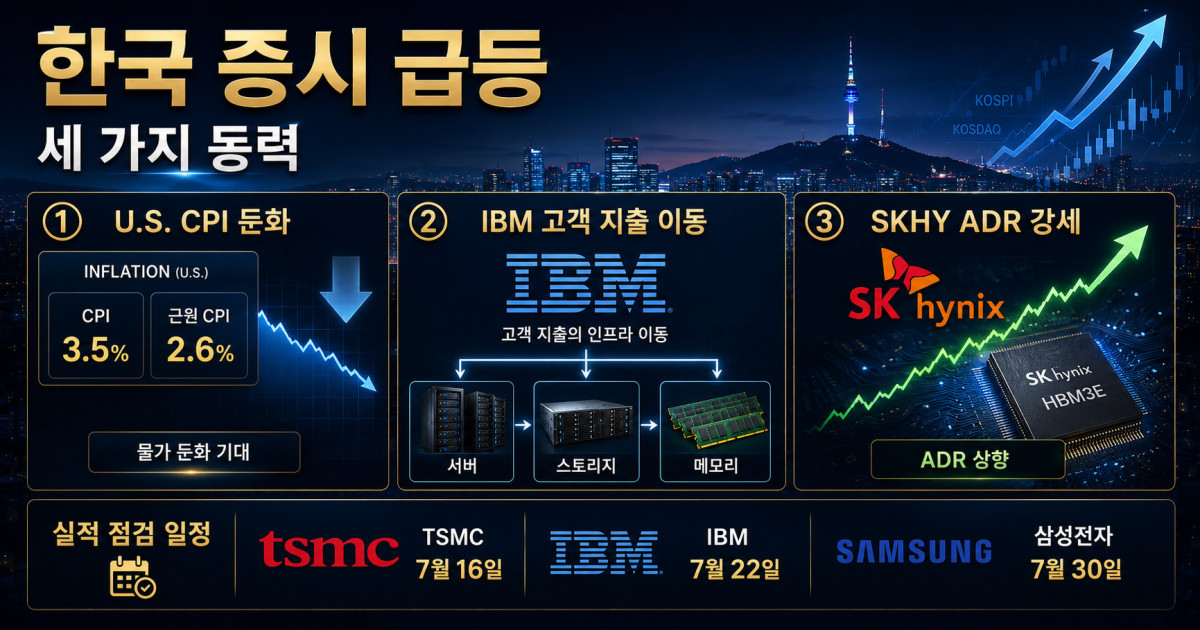
The first catalyst came from the U.S. Bureau of Labor Statistics. June headline consumer inflation was 3.5% year over year and core inflation was 2.6%, both below market expectations. The data reduced concern about additional tightening and another surge in long-term yields. This matters to AI infrastructure because data centers, power systems, networks, accelerators and memory require enormous upfront capital. Higher discount rates pressure valuations, while higher borrowing costs can slow project approvals.
One CPI report does not guarantee hyperscaler capital spending. The defensible conclusion is that a major macro obstacle became less severe. A steadier financing environment gives cloud and technology companies more room to maintain existing investment plans. That is supportive for HBM, server DRAM and enterprise SSD demand. Markets treated the CPI release as evidence against an abrupt capex slowdown, not as proof of a new spending boom.
IBM revealed a shift toward memory spending
IBM’s preliminary second-quarter results were disappointing, but its explanation contained a notable demand signal. In an official letter to investors, CEO Arvind Krishna said clients shifted quarterly capital spending toward servers, storage and memory in the final weeks of June. They were trying to secure supply-constrained infrastructure before expected price increases. IBM said this reprioritization affected buying patterns and contributed to delayed transactions.
The wording deserves care. IBM did not identify specific hyperscalers or confirm the duration of their AI budgets. The comment is not conclusive proof that every cloud operator will keep increasing capex. It remains valuable because it came from a company negatively affected by customers prioritizing hardware and memory elsewhere. Supply constraints and expected price increases were strong enough to alter real corporate budgets. That is an independent demand signal for the memory ecosystem, even if it is not a precise forecast for Samsung Electronics or SK Hynix.
SK Hynix ADR strength restored confidence
The third catalyst was the overnight strength of SK Hynix’s U.S.-traded ADRs. A positive analyst view, bargain hunting and the belief that Korean shares had become oversold pushed the ADRs sharply higher. Because Samsung Electronics and SK Hynix have unusually large KOSPI weights, renewed confidence in the memory cycle can move the entire index. The ADR rally gave Seoul investors a visible reference point after several sessions of extreme uncertainty and strengthened the Korea stock market rally.
Still, an ADR return should never be copied directly into a forecast for the Korean ordinary share. Trading hours, the won-dollar exchange rate, conversion ratios, liquidity, hedging costs and the ADR premium all influence the gap. As discussed in our Samsung Electronics and SK Hynix rebound analysis, premium compression can occur through a rise in the Korean share, relative weakness in the ADR, or both. ADR momentum helped calm fear, but the premium is not a substitute for earnings and cash flow.
Why market breadth matters
The quality of the Korea stock market rally depends on what happened outside the chip leaders. The KOSDAQ rebounded 5.80% from its lowest close of the year, while defense, electronic components and other growth segments participated. A sell-side sidecar had been triggered in the KOSDAQ only one day earlier. The switch to a buy-side sidecar illustrates how forced position reduction, leverage rebalancing and bargain buying can collide in a volatile market.
If foreign net buying continues and the share of advancing stocks remains healthy, the rebound can broaden into a more durable stock-picking market. If trading value and breadth fade while only Samsung and SK Hynix remain strong, the move will look more like short covering and technical mean reversion. Where capital stays after the initial excitement matters more than the closing index alone.
A bottom signal is not a bottom guarantee
July 15 offers evidence of a potential short-term floor. Large foreign and institutional purchases arrived after a severe drawdown, while macro conditions and industry demand signals improved. But a confirmed bottom requires more. Selling pressure should diminish during a retest, earnings estimates should stop falling, foreign flows should persist and leveraged-product rebalancing should become less disruptive.
A 6% surge can also invite profit taking. Investors who see the decline as a long-term accumulation opportunity may be better served by staged purchases than by chasing one strong session. They can divide capital across dates or price zones, focus on businesses whose earnings assumptions remain intact, and retain liquidity for another volatility spike. The risks in our Samsung and SK Hynix selloff analysis should be monitored rather than assumed to have vanished. For the Korea stock market rally to last, the next pullback must be calmer than the previous decline.
The earnings-season checklist
The next checkpoint is TSMC’s second-quarter earnings call on July 16. Investors should listen for AI-accelerator demand, advanced-node utilization, packaging bottlenecks and second-half capex guidance. IBM plans its regular call for July 22, when management may add context to its preliminary shortfall. Samsung Electronics scheduled its second-quarter call for July 30. SK Hynix’s report will need to confirm HBM shipments, long-term supply agreements, conventional DRAM pricing, capacity and next-quarter guidance.
NVIDIA and other AI-platform companies remain later checkpoints, but investors should verify each date through the relevant official investor-relations calendar. Data-center growth, backlog, supply constraints, customer concentration and capital-spending growth will reveal whether demand is broad and sustainable. If these indicators remain firm, the Korea stock market rally can develop into a fundamentals-led recovery. If capex plans weaken or memory-price expectations roll over, volatility could return quickly.
Conclusion: fear eased, but verification remains
The July 15 Korea stock market rally was built on three credible signals. Softer U.S. CPI reduced rate anxiety. IBM showed that servers, storage and memory had become a high spending priority for clients. SK Hynix ADR strength reinforced the view that the Korean chip selloff had become excessive. Combined with large foreign purchases, those developments restored confidence across both Korean markets.
Yet the rally is a starting point, not a final verdict. A durable floor becomes more plausible only if AI infrastructure spending and memory demand survive earnings season, foreign buying continues during pullbacks and earnings expectations stabilize. Until then, staged accumulation, official disclosures and respect for volatility are more prudent than aggressive performance chasing.
Sources
This analysis uses the U.S. CPI release, IBM investor letter, a July 15 market report, and official TSMC and Samsung investor calendars.
This article is for informational purposes only and does not constitute investment advice. Investment decisions and their consequences remain the responsibility of the investor. Verify the latest disclosures and market information before making any investment decision.