 Korean Stock Insight
Situational Awareness Hedge Fund Unwind: What It Means for SK Hynix and AI Stocks
The Situational Awareness hedge fund unwind offers an important clue to the violent decline and rebound in AI infrastructure stocks. Earnings expectations for SK Hynix, data-center power suppliers and storage companies did not disappear overnight. A concentrated portfolio using substantial leverage appears to have reduced public-market risk after losses intensified, creating a flow shock that may have overwhelmed company-specific fundamentals. Calling the event proof that the AI investment thesis has collapsed would confuse an industry’s outlook with one portfolio’s financing structure. Yet assuming the market has bottomed simply because a large seller has stepped away would be equally premature.
What happened to the Situational Awareness hedge fund
Situational Awareness was founded by former OpenAI researcher Leopold Aschenbrenner. Its investment thesis centered on the idea that rapid AI development would create bottlenecks in computing, electricity, data centers, networking, storage and memory. That approach produced concentrated exposure to public and private companies tied to AI infrastructure. It also meant that several apparently different holdings could fall together when investors questioned the pace or economics of hyperscaler capital spending.
Axios reported on July 30, 2026 that the firm sold its public-equity portfolio to Citadel. A subsequent Cinco Días account said the firm still held private investments, including an Anthropic stake. The confirmed public-portfolio sale should therefore not be described as the legal liquidation or bankruptcy of the entire investment firm. It is more accurately viewed as a major deleveraging of listed positions.
Why the Situational Awareness hedge fund problem was leverage, not AI
Leverage amplifies gains when markets rise, but it also accelerates losses and collateral pressure when positions move the wrong way. A manager using borrowed money can hold exposure far larger than the equity capital supplied by investors. A 10% decline in the underlying assets can therefore translate into a much larger loss on the fund’s capital. When collateral values fall below agreed thresholds, prime brokers may request additional cash, reduce credit or demand lower gross and net exposure.
At that point, valuation analysis can become secondary. A manager may need to sell liquid listed shares even when the companies still have attractive long-term prospects. The relevant deadline is the margin call, not the next earnings report. This distinction explains how an investment thesis can remain plausible while the portfolio built around it becomes unsustainable. A good company, a good thesis and a survivable position are three different things.
How the Situational Awareness hedge fund unwind distorted prices
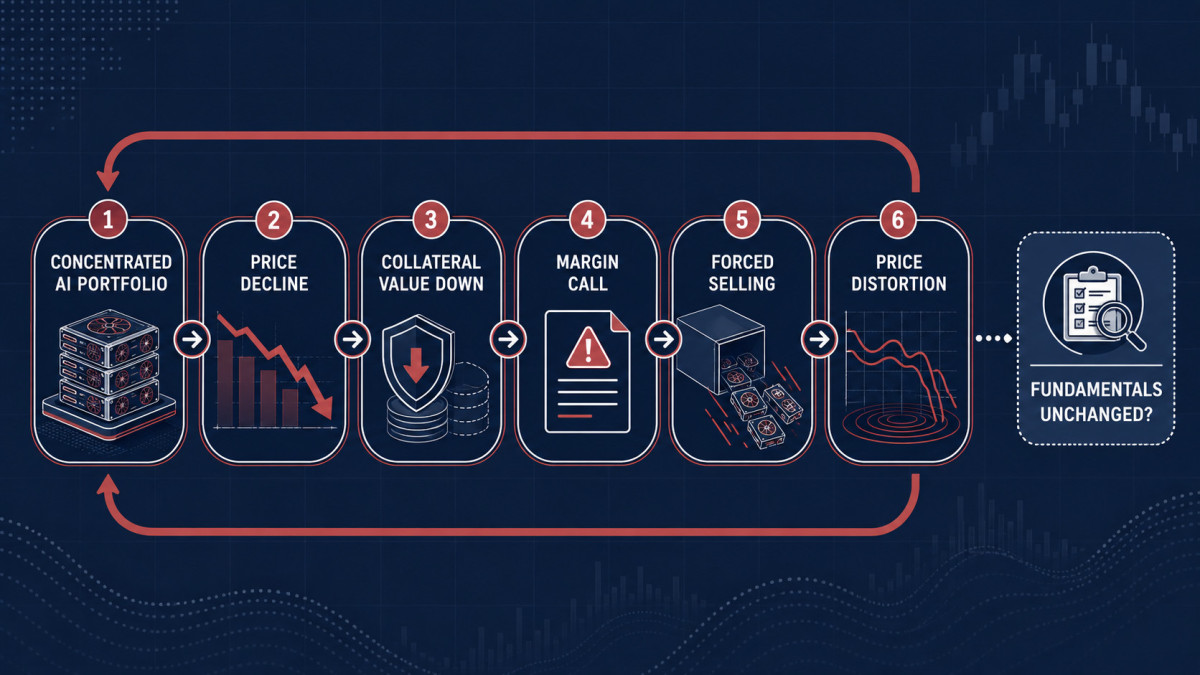
A forced unwind usually follows a feedback loop. Falling prices reduce collateral values. Lower collateral triggers margin requirements and tighter risk limits. The fund raises cash by selling positions, and those sales push prices lower, potentially creating another round of risk reduction. The effect is strongest in securities with limited liquidity or crowded institutional ownership.
Other investors may interpret the price decline as evidence of new fundamental bad news, even when the original catalyst was mechanical selling. Systematic strategies can add to the pressure as volatility rises and price trends weaken. The reverse can happen after the sale is complete: prices may rebound sharply without a new earnings catalyst because the market no longer has to absorb the same urgent supply. Both the decline and the rebound should be tested against changes in earnings expectations, not judged by price action alone.
Why the Situational Awareness hedge fund exposed SK Hynix and AI stocks
The fund’s thesis linked AI growth to demand for HBM, conventional server memory, storage, power generation and data-center capacity. These businesses occupy different industries, but their valuations depend on a shared variable: whether hyperscalers can continue converting large capital expenditures into durable cloud and AI revenue. When a concentrated investor reduces several positions simultaneously, their correlations can suddenly rise even if operating results remain different.
SK Hynix is particularly sensitive because its market narrative is closely tied to HBM demand and global institutional positioning. A large offshore risk reduction can affect the Korean share price, related derivatives and investor sentiment before domestic investors can determine whether memory forecasts have actually changed. Still, it would be too strong to attribute the entire AI-stock correction to one fund. Elevated valuations, interest rates, financing costs and doubts about the return on AI capital expenditure were already present. The Situational Awareness hedge fund event is a credible flow factor, not a complete explanation for every market move.
A portfolio sale is not the same as legal liquidation
Financial headlines often use the word liquidation loosely. Selling a public-equity book, winding down a fund, liquidating a legal entity and entering bankruptcy are different events. The evidence currently supports a substantial sale of listed positions to Citadel and continued ownership of some private assets. Investors should avoid claims that all assets became worthless or that the entire firm disappeared unless official documents establish those facts.
The distinction also affects market analysis. Completion of the public-stock transfer may remove a major source of near-term supply, but it does not prove that investor redemptions, financing negotiations or other obligations have been resolved. Follow-up reporting and regulatory filings matter more than confident social-media narratives.
Why a rebound does not prove the trend is back
Once forced supply clears, prices can normalize quickly. Short covering, bargain hunting and a temporary absence of sellers can produce a powerful rally. A durable uptrend requires more: AI infrastructure companies must deliver revenue, margins and cash flow, while hyperscalers must show that their capacity additions are being used by customers.
Overhead supply also remains after a sudden decline. Investors who bought near the previous peak may sell as prices recover toward their entry levels. The market must absorb those shares before a stable trend can emerge. Investors should watch whether volume remains constructive, whether closing prices hold after early rallies and whether earnings estimates stabilize. One strong session is evidence that selling pressure eased, not proof that every risk has disappeared.
Three signals investors should monitor
- Earnings and cash flow: Are AI infrastructure orders, revenue, margins and cash generation meeting expectations?
- Funding conditions: Are long-term yields and credit spreads stabilizing, and can hyperscalers finance expansion without undermining returns?
- Market normalization: Are institutional selling, short activity and volatility easing as prior resistance levels are tested?
The user’s original Korean analysis is available in the Naver Blog post. This Korea Stock Insight version reorganizes the event around a central distinction: the long-term AI infrastructure thesis and the short-term survival of a leveraged portfolio must be evaluated separately.
Conclusion: an investment thesis must survive its financing
The Situational Awareness hedge fund episode does not by itself prove that long-term AI demand is broken. It shows that even a compelling theme can end in forced selling when leverage, concentration and liquidity are poorly matched. The public-equity sale may reduce a significant short-term source of pressure, but a genuine recovery will be confirmed only when earnings and cash flow regain control of prices. Investors should resist both extremes: treating every decline as proof that AI is over and treating every rebound as permission to ignore valuation and risk.
This article is for informational purposes only and does not constitute investment advice. Investment decisions and their consequences remain the responsibility of the investor. Verify the latest disclosures and market information before making any investment decision.