 Korean Stock Insight
AWS AI Investment Payback: Why HBM Demand Matters for Korean Memory Stocks
Whether AWS AI investment is generating real economic returns matters far beyond Amazon shareholders. It is also central to the outlook for Samsung Electronics and SK Hynix. If hyperscalers spend heavily on data centers and AI servers without converting capacity into customer usage and cash flow, forecasts for HBM and server DRAM will eventually weaken. If new capacity is sold quickly and equipment costs can be recovered well before the hardware reaches the end of its useful life, AI infrastructure begins to look like a repeatable business rather than a speculative experiment. Amazon’s second-quarter 2026 results provide evidence that can be tested through revenue and operating profit.
How AWS AI investment earnings answer the capex question
According to Amazon’s official second-quarter 2026 release, AWS revenue rose 37% year over year to $42.2 billion, its fastest growth in 18 quarters. AWS operating income increased from $10.2 billion to $16.6 billion. Amazon also said the annualized revenue run rates of both its AWS AI business and its chips business exceeded $25 billion. These figures show that expanding AI infrastructure is being accompanied by cloud usage and segment profit, not merely by a promise of future demand.
Investors should avoid using Amazon’s consolidated net income as a pure measure of AI profitability. The quarter included a large non-operating gain primarily related to Amazon’s Anthropic investment. AWS revenue, segment operating income, customer commitments and capacity utilization are therefore more useful for evaluating the operating economics of cloud and AI infrastructure.
How to interpret the AWS AI investment payback comment
During the earnings discussion, Amazon management explained that spending on servers and networking equipment reaches break-even, on average, in a little less than three years, while the equipment can remain useful for at least five to six years. The statement suggests that Amazon deploys hardware against substantial demand and long-term commitments, recovers the equipment investment before the end of its service life and can continue generating cash flows afterward.
That is meaningful evidence in favor of AWS AI investment, but it is not a guaranteed return calculation. Investors need to know exactly which costs are included in the payback period. Servers and networking equipment are only part of a data center. Buildings, land, power connections, cooling systems, financing and ongoing operations also require capital. Average payback can vary by region, customer contract, hardware generation and utilization rate. The figure should not be applied mechanically to every AWS facility or every accelerator.
Costs an AWS AI investment payback calculation leaves out
If an equipment investment of 100 is recovered within three years and the equipment remains in service for five or six years, additional cash generation is possible. It would still be misleading to claim that the investment automatically doubles. Electricity, cooling, networking, maintenance, labor and software costs continue throughout the asset’s life. Data-center construction and funding costs may sit outside the narrow equipment calculation. Rapid improvement in AI accelerators can also make hardware economically obsolete before its accounting life ends.
Investors should combine the payback comment with AWS operating margin, Amazon’s property-and-equipment spending, free cash flow and reported supply constraints. Amazon disclosed that trailing-twelve-month free cash flow turned negative as property-and-equipment purchases rose sharply, primarily reflecting AI investment. AWS profitability improved at the same time that group-level cash requirements increased. Both sides of that equation matter.
Why custom AI chips still need HBM
Viewing AI accelerators as a winner-takes-all contest between Nvidia GPUs and custom ASICs can obscure the memory opportunity. Regardless of who designs the compute engine, large models need high-capacity, high-bandwidth memory to supply weights, training data and the key-value cache generated during inference. Even if custom chips take some share from GPUs, total HBM demand can expand when the number of AI servers, model size, context length and inference volume all increase.
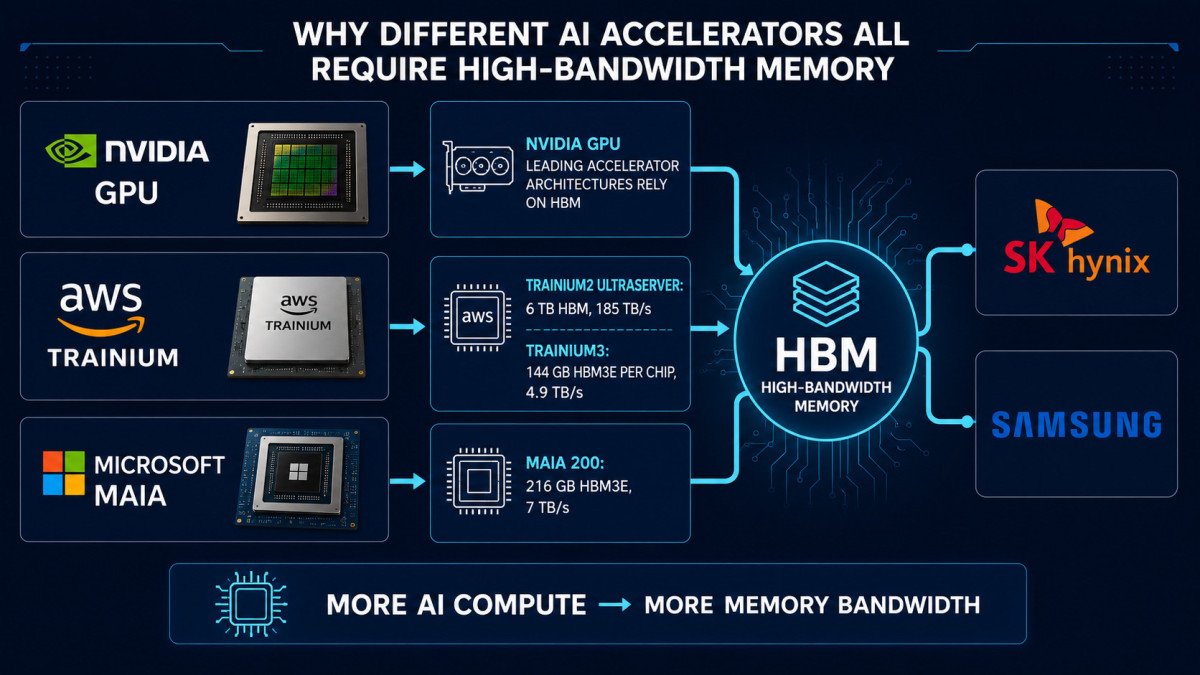
AWS is deploying its own Trainium accelerators alongside third-party GPUs. AWS specifications for Trainium2 state that a Trn2 instance provides 1.5 TB of HBM and 46 TB per second of aggregate memory bandwidth, while a Trn2 UltraServer reaches 6 TB of HBM and 185 TB per second. The next-generation Trainium3 uses 144 GB of HBM3E per chip with 4.9 TB per second of bandwidth. Custom silicon is not removing HBM from the system; it is creating another route to demand.
What Trainium and Maia reveal about memory intensity
The same design direction appears at Microsoft. The company’s official Maia 200 introduction specifies 216 GB of HBM3E and 7 TB per second of memory bandwidth per accelerator. Meanwhile, Microsoft’s fiscal fourth-quarter 2026 results showed Azure and other cloud-services revenue rising 43%, while annual Azure revenue surpassed $100 billion for the first time.
Different accelerator brands are converging on the same requirement: compute units must be continuously supplied with data. Larger models, longer context windows, multimodal workloads and autonomous agents increase not only arithmetic operations but also the volume and speed of data movement. Memory capacity and bandwidth must scale with compute performance. The common denominator of the AI ecosystem is not a single GPU model; it is the memory system that prevents expensive accelerators from sitting idle.
The connection to Korean memory suppliers
Korea does not dominate global cloud platforms, but Samsung Electronics and SK Hynix are critical suppliers of HBM and server memory. If AWS, Microsoft and other hyperscalers use a mixture of Nvidia GPUs and their own chips, the accelerator ecosystem becomes more diverse. At the same time, the importance of qualifying advanced HBM products across multiple customers and platforms increases.
The benefit to Korean suppliers is not automatic. Customer qualification schedules, generation transitions, production yields, advanced packaging capacity and competing supply determine actual market share and pricing. Rapid capacity expansion could eventually pressure memory margins. Nevertheless, the adoption of high-capacity HBM by custom accelerators demonstrates that Korean memory demand is not tied to Nvidia alone. More accelerator types and more deployed AI servers can broaden the addressable market.
Risks investors should monitor
- Profitability: Are cloud revenue and operating profit growing fast enough to justify higher capital expenditure?
- Utilization: Is newly installed AI capacity being converted into contracts and real customer usage?
- Cash flow: How much pressure do data-center spending and financing place on free cash flow?
- Memory supply: Could rapid HBM capacity additions reduce pricing and margins sooner than expected?
- Company execution: Can Samsung Electronics and SK Hynix meet qualification, yield and packaging requirements?
The user’s original Korean Naver analysis connected Amazon’s results to the Korean memory opportunity. This Korea Stock Insight version adds official earnings and accelerator specifications so that readers can evaluate investment payback and HBM demand as related but separate questions.
Conclusion: AWS AI investment is moving from expectation to economic testing
AWS AI investment still consumes enormous amounts of cash, but 37% AWS revenue growth and higher segment operating income show that new compute capacity is reaching paying customers. Management’s equipment-payback comment supports the possibility that AI servers and networking assets can recover their cost well before the end of their service life. Negative free cash flow and rising capital intensity remain important counterweights.
For Korean investors, the key conclusion is that they do not need to predict one permanent winner in AI accelerators. Nvidia GPUs, AWS Trainium and Microsoft Maia all require high-bandwidth memory. If AI service usage continues to expand and the compute ecosystem becomes more diverse, HBM and server DRAM can remain shared bottlenecks. A favorable industry outlook is not the same as an attractive stock entry price, however. Earnings execution, supply growth, valuation and cash flow must still be evaluated together.
This article is for informational purposes only and does not constitute investment advice. Investment decisions and their consequences remain the responsibility of the investor. Verify the latest disclosures and market information before making any investment decision.