 Korean Stock Insight
KOSPI 7000 Faded to 6,797: Three Reasons Foreign Buying Was Not Enough
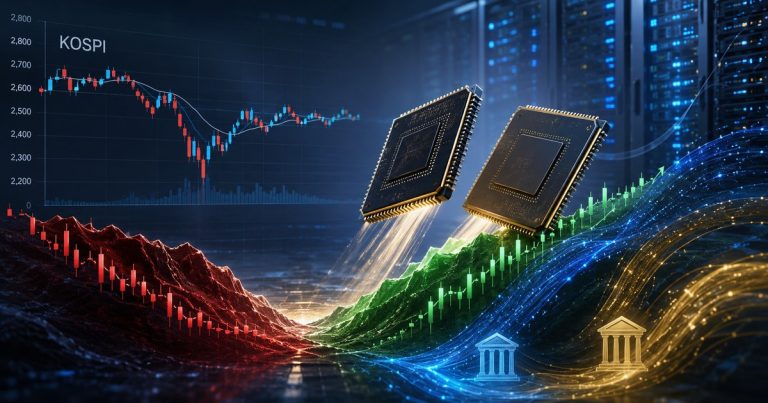
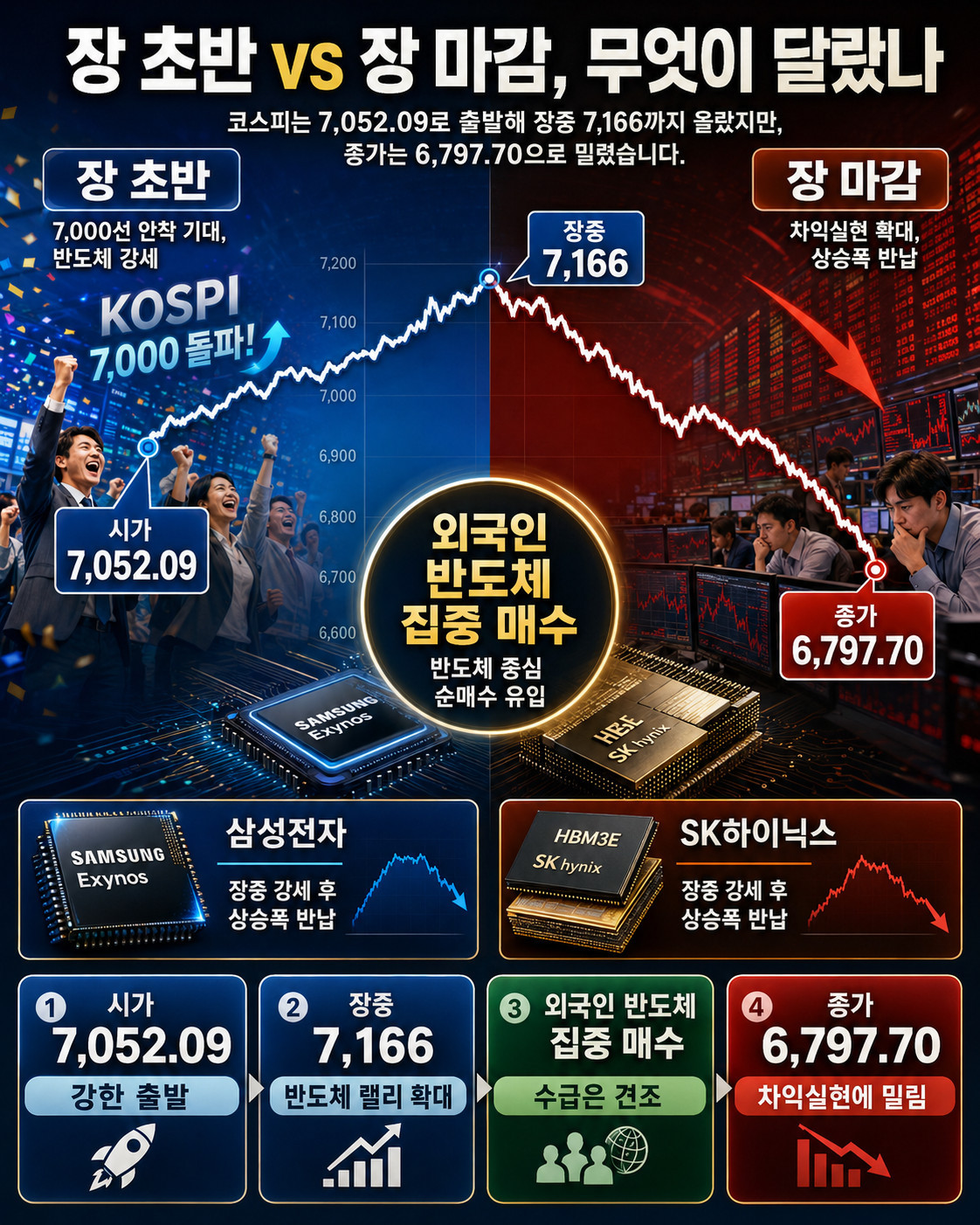
KOSPI 7000 appeared to have arrived again. South Korea’s benchmark opened at 7,052.09, up 4.51% from the previous close, surged as high as 7,166 and triggered a buy-side sidecar as futures jumped. By the closing bell, however, the index stood at 6,797.70, a gain of only 0.74%. The market fired the confetti in the morning and received the bill in the afternoon. The reversal deserves more than a simple explanation about an overbought market. Foreign investors bought roughly KRW 2.6 trillion of KOSPI shares, yet the index surrendered more than 368 points from its intraday peak. The real question is not how much foreign money entered, but where it went, who sold into it and why investors stopped bidding before the close.
US chip stocks opened the door to KOSPI 7000
The immediate catalyst came from Wall Street. The Philadelphia Semiconductor Index climbed 5.2% in the prior U.S. session, while memory and storage names including Micron rebounded sharply. That move revived confidence after fears about weaker AI infrastructure spending had punished semiconductor shares. Korean investors responded at the open by directing heavy orders toward Samsung Electronics and SK Hynix.
The opening was spectacular. SK Hynix rose as much as 9.26% to KRW 2,006,000, while the KOSPI quickly reclaimed 7,000. The excitement did not survive the full session. SK Hynix finished 0.33% lower at KRW 1,830,000 and Samsung Electronics closed only 0.58% higher at KRW 260,500. A SBS report on the July 22 close confirmed the 6,797.70 finish and the concentrated foreign buying in the two chip leaders. Wall Street determined the opening gap, but Korean profit-taking and caution about the next earnings catalyst determined the close.
From the opening surge to the closing fade
| Item | Opening or intraday | Close |
|---|---|---|
| KOSPI | Opened at 7,052.09 | 6,797.70, up 0.74% |
| Intraday high | 7,166.00 | More than 368 points below the high |
| Samsung Electronics | Strong opening | KRW 260,500, up 0.58% |
| SK Hynix | KRW 2,006,000, up 9.26% | KRW 1,830,000, down 0.33% |
| Foreign investors | Aggressive chip buying | About KRW 2.6 trillion net buying on KOSPI |
The most revealing number is not 7,000. It is the distance between the high and the close. An opening gap rapidly imports information from the U.S. session. The close shows whether domestic investors accepted that new price after a full day of trading. The market crossed KOSPI 7000; it did not establish the level as support.
Reason one: profit-taking overwhelmed the foreign bid
The first reason was simultaneous selling by Korean retail and institutional investors. Foreign investors purchased about KRW 2.6 trillion on the main board. Individuals sold roughly KRW 1.2 trillion and institutions sold close to KRW 1.4 trillion. Foreign money was filling the pool while the two domestic groups were removing almost the same amount from the opposite side. The index faded not because the foreign bid was small, but because a large inventory of shares was waiting to use the high opening as an exit.
The composition of foreign buying matters even more. Foreign investors bought approximately KRW 1.256 trillion of SK Hynix and KRW 583.4 billion of Samsung Electronics. Around KRW 1.84 trillion therefore went into just two companies. The more accurate interpretation is that global investors selected Korea’s two major AI-memory companies, not that they broadly embraced the entire Korean equity market. A large headline flow can coexist with weak market breadth when most of the money is concentrated in the index’s largest constituents.
This distinction explains why the KOSPI could remain positive while many investors felt that the session was weak. Large-cap index weights amplified the morning rally, but the rest of the market did not provide enough secondary demand to absorb profit-taking. The Korean-language market-close report from EToday also documented the muted final gains in Samsung and the decline in SK Hynix. Foreign buying was real and potentially constructive, but it was narrow rather than universal.
Reason two: Alphabet earnings became the next test
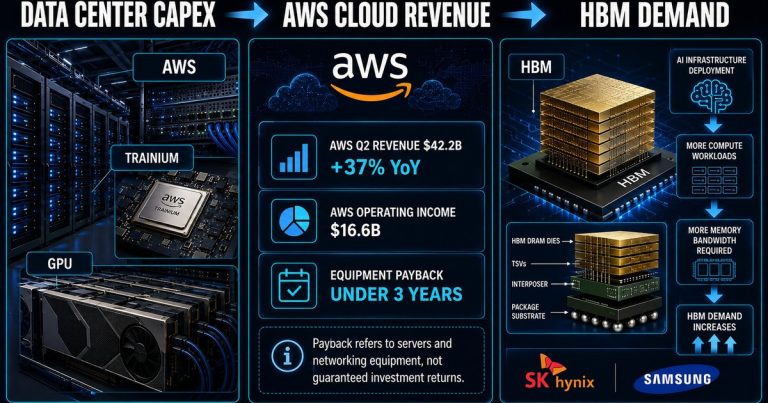
The second reason was caution ahead of Alphabet’s results. For memory investors, the crucial questions are not limited to advertising revenue or a one-quarter earnings beat. Google Cloud growth and management’s plan for AI data-center capital spending have become more important. If Alphabet says it will continue expanding infrastructure aggressively, expectations for HBM, server DRAM and enterprise SSD demand can strengthen. If management emphasizes capital discipline, slower deployment or pressure on returns, the high earnings assumptions embedded in Samsung Electronics and SK Hynix can face a valuation discount.
Semiconductor shares increasingly react to a forward-looking question: will hyperscalers keep spending at the current pace? Strong reported numbers are useful, but they describe demand that has already occurred. Guidance on data centers, accelerators, networking and cloud capacity tells investors whether memory demand can remain strong into the next cycle. The official Alphabet investor-relations notice placed that decision point directly in front of the market.
That timing encouraged some investors to reduce risk after the opening surge. Even a good earnings report can produce limited upside when the share price has already moved sharply in anticipation. The market therefore waited less for the headline earnings-per-share figure than for management’s language on cloud demand and AI capex. In this context, the intraday retreat was not necessarily a rejection of the long-term AI-memory thesis. It was also a rational decision to avoid paying the morning’s highest price before a major customer signal.
Reason three: the rally was too dependent on two chip stocks
The third reason was excessive dependence on Samsung Electronics and SK Hynix. The KOSPI closed higher, but the KOSDAQ fell 0.30% to 751.09. The smaller-company index had opened 2.53% higher and at one stage gained more than 4%, only to reverse into negative territory. If risk appetite had broadened across the market, smaller growth companies and the KOSDAQ should have retained at least part of their gains into the close.
Instead, capital remained concentrated in the largest semiconductor names. When both stocks surrendered their advances, the index lost power with them. It was a market with two engines, and both engines reduced thrust in the afternoon. This is why investors should monitor the number of advancing stocks, turnover by sector, KOSDAQ relative strength and whether foreign purchases spread beyond the top two companies. The KOSPI 7000 headline was dramatic, but market breadth offered a less enthusiastic message.
Narrow leadership is not automatically bearish. Concentrated buying in companies with global earnings exposure can become the first stage of a broader recovery. The warning arises when the rest of the market repeatedly fails to follow and the leaders cannot hold their own opening gains. In that case, the benchmark can print a milestone without building a durable base underneath it.
A practical framework for the next session
First, investors should avoid treating another large opening gap as confirmation by itself. Watch whether foreign cash buying and program demand remain positive after the first 30 minutes and through the afternoon. In a market that repeatedly gives back opening gains, the ability to hold a price matters more than the speed with which it was reached. Falling turnover near the previous high or a shift toward foreign futures selling would make momentum chasing more dangerous.
Second, examine Alphabet’s cloud growth and data-center capex plan rather than relying on a simple earnings beat or miss. A commitment to expand AI servers, networks and facilities would support the demand case for SK Hynix HBM, Samsung’s advanced memory, server DRAM and enterprise SSDs. A more cautious spending message would not destroy the semiconductor fundamentals overnight, but it could reset expectations and extend volatility.
Third, analyze Samsung Electronics and SK Hynix separately. Foreign investors bought both aggressively, yet SK Hynix crossed KRW 2 million intraday and still closed lower. That does not prove that long-term demand has weakened. It does show that supply from profit-takers and short-term position adjustments was substantial at higher prices. Samsung has a broader business mix and a different path for monetizing HBM demand, so one stock’s flow should not be mechanically applied to the other.
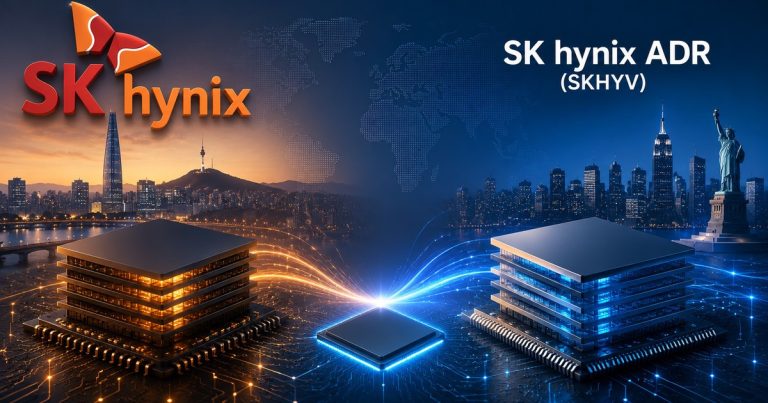
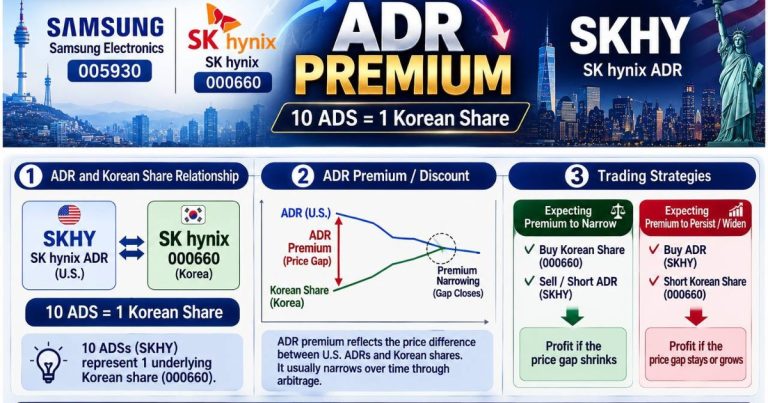
Readers who want to understand how SK Hynix’s U.S. listing can influence Korean trading can also review our analysis of the SK Hynix ADR premium and short-selling flows. A strong ADR is a positive price-discovery signal, but the gap can narrow through Korean-share gains, ADR weakness or currency movement. That framework helps explain why an enthusiastic U.S. close does not always produce an equally strong Seoul close.
Conclusion: the close matters more than the milestone
The intraday break above KOSPI 7000 showed that semiconductor confidence remains alive and that global investors are willing to commit large amounts to Samsung Electronics and SK Hynix. Those are constructive signals. Yet the retreat from 7,166 to 6,797 also showed that overhead supply and earnings-event risk remain substantial. The KRW 2.6 trillion foreign inflow matters, but its concentration in two chip companies limits what it says about the health of the broader market.
Three developments now matter most: whether foreign buying continues into the next session, whether Alphabet maintains an aggressive AI infrastructure plan, and whether gains and turnover spread beyond the semiconductor leaders. If those conditions arrive together, KOSPI 7000 can evolve from an intraday print into a more credible support area. Until then, investors should pay more attention to the close than the opening celebration. Markets often sell hope in the morning and send the invoice in the afternoon.
Sources and data note
Closing levels, stock moves and investor flows were compiled from reports citing Korea Exchange data. Published flow totals differ slightly by outlet, so this article uses approximately KRW 2.6 trillion for foreign net buying. Readers should refresh exchange statistics and company disclosures before making an investment decision.
This article is for informational purposes only and does not constitute investment advice. Investment decisions and their consequences remain the responsibility of the investor. Verify the latest disclosures and market information before making any investment decision.