 Korean Stock Insight
SK Hynix ADR Trades at a 16.0% Premium: Will Korean Shares Catch Up?
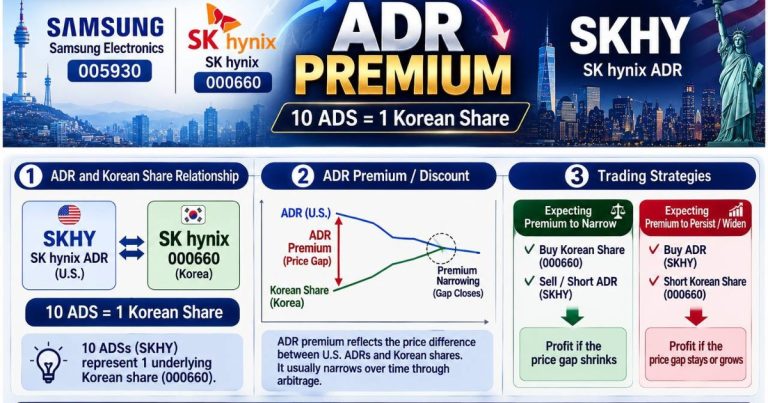
The SK Hynix ADR premium reached 16.0% on a simple implied basis, but it does not guarantee an equivalent rise in Korean shares. The U.S. debut created a striking price gap with its Korean-listed common shares. The ADR closed its first regular session at $168.01. Applying the confirmed ratio of ten ADRs per Korean share and the comparison exchange rate of KRW 1,509.9 per dollar produces an implied Korean-share value of KRW 2,536,783. Against the previously established Korean close of KRW 2,186,000, that equals a simple implied premium of about 16.0%.
How the SK Hynix ADR premium was calculated
| Item | Value |
|---|---|
| ADR close | $168.01 |
| Depositary ratio | 10 ADRs = 1 Korean share |
| Comparison exchange rate | KRW 1,509.9 per USD |
| Implied Korean-share value | KRW 2,536,783 |
| Korean-share close | KRW 2,186,000 |
| Simple implied premium | 16.0% |
The arithmetic is $168.01 × 10 × 1,509.9 = KRW 2,536,782.99. Dividing that amount by the Korean close and subtracting one gives 16.0468%, rounded to 16.0%. This is not a target return or a guaranteed arbitrage spread. It is a currency- and ratio-adjusted comparison between prices formed at different times.
Why did the U.S. price form at a premium?
U.S. investors may view SK Hynix as one of the clearest listed exposures to high-bandwidth memory and AI infrastructure spending. The Nasdaq listing also broadened access beyond investors already active in Korea. Trading alongside Micron may encourage investors to compare growth, HBM leadership, margins, and valuation more directly. Strong debut demand therefore offers useful price-discovery information, even if part of that information reflects temporary listing dynamics.
Why Korean shares do not have to rise 16%
The Korean reference price was set when Seoul closed on July 9, while the ADR price was formed later in the U.S. session on July 10. Korean shares may not yet have reflected the first U.S. close. At the same time, the ADR may include a first-day premium caused by concentrated demand and limited tradable supply. Conversion procedures, settlement timing, foreign-exchange costs, and practical arbitrage limits can prevent an immediate convergence.
Three ways the gap can narrow
Korean shares could rise toward the ADR-implied value. The ADR could fall as first-day enthusiasm normalizes. More realistically, Korean-share gains, ADR adjustment, and USD/KRW movement may all contribute. The key question is not whether the full 16.0% appears in Korea, but where and how price discovery continues.
Scenarios for Korea’s next session
Upside scenario
Foreign buying strengthens, HBM sentiment improves, and part of the ADR premium is reflected in the Korean open and subsequent trading. Sustained volume would make the signal more meaningful.
Neutral scenario
The stock opens higher but gives back part of the move as investors take profits. Korean shares advance modestly while the ADR normalizes, narrowing the gap from both sides.
Downside scenario
The ADR’s listing premium contracts rapidly, U.S. semiconductor shares weaken, or Korean institutions and foreign investors take profits. Korean shares could then underperform the optimistic interpretation of the U.S. debut.
What investors should monitor
- Foreign net buying and program trading after the Korean open
- Volume and the ability to hold the opening gain
- SKHY premarket and regular-session movement
- USD/KRW and major U.S. semiconductor indexes
- Actual ADR conversion timing, costs, and restrictions
Conclusion
The 16.0% simple implied premium indicates that U.S. investors assigned a strong first-day price to SK Hynix’s AI-memory and HBM exposure. It may place upward pressure on Korean shares, but it does not guarantee that the entire premium will become a Korean-share gain. A combination of Korean repricing, ADR normalization, and currency movement is a more balanced expectation.
Structural variables behind the SK Hynix ADR premium
The SK Hynix ADR premium can persist temporarily because an ADR is not an instant copy of the Korean share. Depositary conversion procedures, settlement timing, holidays, currency spreads, and freely tradable supply all matter. As liquidity develops, professional investors can compare both markets more efficiently, but convergence may still occur through movement on both sides.
Investors should distinguish an opening gap from durable price discovery. A high Korean open followed by falling volume and foreign selling would weaken the signal. A pullback followed by renewed buying and strong volume would provide better evidence that the U.S. valuation is influencing Korea.
Related semiconductor analysis
For more context, see our Korean HBM equipment analysis and recent Korea market wrap.
Sources and calculation basis
AP, Electronic Times, and Nasdaq Trader supplied the market inputs. The implied value and 16.0% premium are our calculations.
Sources
AP supplied the first-day ADR close. Electronic Times supplied the Korean close and comparison exchange rate. Nasdaq Trader supplied the SKHYV launch and SKHY transition schedule. The implied value and 16.0% premium are our calculations using those inputs.
This article is for informational purposes only and does not constitute a recommendation to buy or sell any security. Investors are responsible for their own decisions and outcomes.
This article is for informational purposes only and does not constitute investment advice. Investment decisions and their consequences remain the responsibility of the investor. Verify the latest disclosures and market information before making any investment decision.