 Korean Stock Insight
KOSPI Outlook for August 18: Three Tests That Matter More Than 7,000
The KOSPI outlook for August 18 is not simply a question of whether South Korea’s benchmark crosses 7,000 again. On August 14, the KOSPI gained 2.42% to close at 6,977.94 after reaching an intraday high of 7,010.86. The index saw 7,000 for the first time in 15 trading sessions, but it could not hold the level into the close. Korea’s market was shut on August 17 for the substitute Liberation Day holiday, which means the next session on Tuesday, August 18 must absorb several days of overseas semiconductor trading and accumulated domestic orders at once.
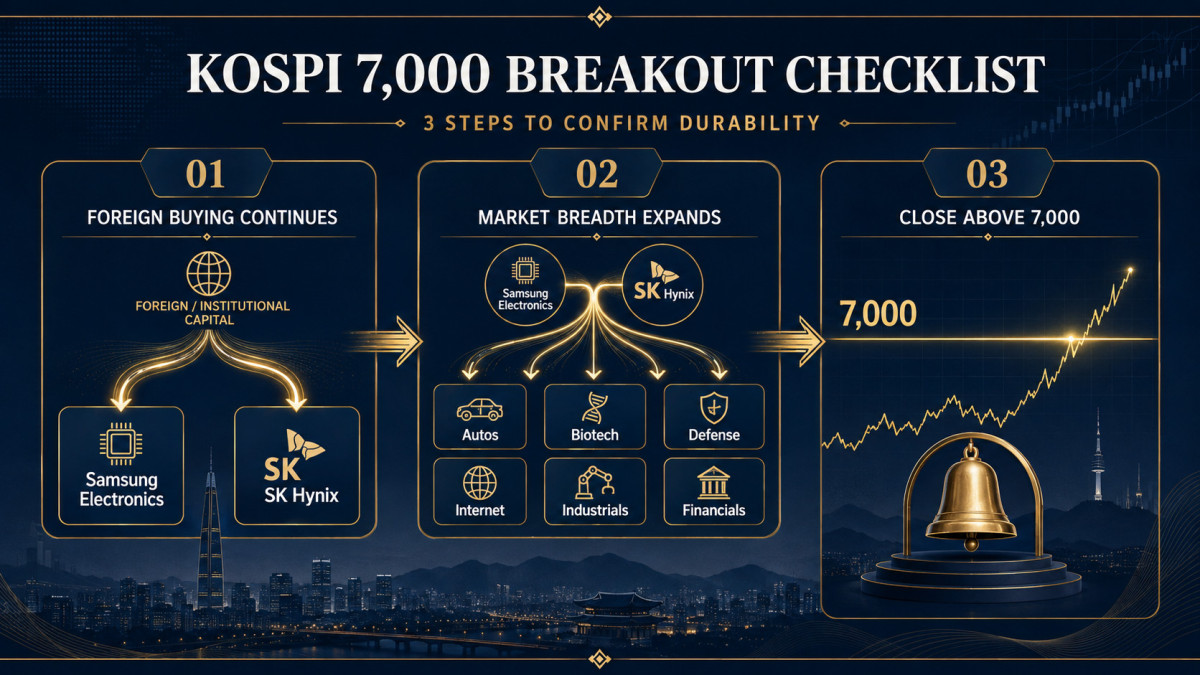
The KOSPI outlook for August 18 therefore depends on three tests that matter more than the opening print: whether foreign buying continues, whether gains spread beyond Samsung Electronics and SK Hynix, and whether the index can finish above 7,000.
KOSPI outlook for August 18 starts from 6,977.94
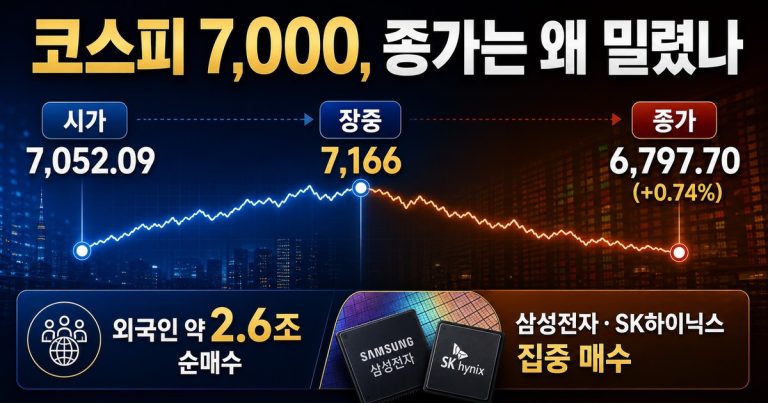
The August 14 price sequence explains why the close deserves more attention than the headline. The KOSPI opened at 6,995.67, traded as high as 7,010.86 and then settled at 6,977.94. The market already proved that it can cross 7,000 intraday. It has not yet proved that buyers can absorb supply above that level through the closing auction.
The speed of the rebound adds another complication. From 6,258.77 on August 7 to 6,977.94 on August 14, the index advanced about 11.5% in one week. Such a fast move can attract momentum buyers and profit-takers at the same time. The Korea Exchange data portal should therefore be used to monitor not only the index but also investor flows, program trading, sector performance and the number of advancing and declining stocks. A 7,000 print accompanied by weaker breadth would be less convincing than a temporary dip supported by persistent foreign buying and broad participation.
First test: do foreign investors keep buying Korean chips?
Foreign investors were the main buyers on August 14, purchasing roughly KRW 3 trillion of KOSPI shares on a net basis while retail and institutional investors were net sellers. Samsung Electronics closed at KRW 274,500, up 2.43%, and SK Hynix ended at KRW 1,645,000, up 3.26%. Both stocks recorded a fourth consecutive gain. Their enormous index weights meant that concentrated foreign demand for the two chip leaders was enough to pull the KOSPI back toward 7,000.
For the KOSPI outlook for August 18, the first practical checkpoint is foreign cash-market flow around 10 a.m. Korea time. If the index opens above 7,000 but foreign investors reverse to net selling in Samsung Electronics and SK Hynix while futures demand weakens, the breakout will have limited credibility. If the index fluctuates near 7,000 while foreign cash buying persists and the won remains stable, the volatility may represent supply absorption rather than rejection. Intraday flow estimates can change materially, however, so the morning reading is an early signal rather than a final verdict.
Second test: does strength spread beyond Samsung and SK Hynix?
Market breadth was less impressive than the headline on August 14. KOSPI large-cap stocks rose 2.48%, compared with 1.82% for mid-caps and 1.39% for small-caps. The KOSDAQ gained only 0.38%. That gap shows that the rebound depended heavily on the largest semiconductor names. It is therefore a central breadth test in the KOSPI outlook for August 18.
Leadership from Samsung Electronics and SK Hynix is constructive, but a market powered by only two engines is vulnerable when either one pauses. The August 18 session will be healthier if buying expands into power equipment, automobiles, shipbuilding, financials, biotechnology and smaller companies. Through August 11, 87.5% of KOSPI constituents had reportedly risen during the month, while the KOSPI 200 mid- and small-cap index had gained 12%. A return of that participation would transform 7,000 from a chip-driven index number into a broader equity advance.
Investors can test breadth through three observations: whether advancing stocks consistently outnumber decliners, whether the KOSDAQ participates, and whether trading value grows outside semiconductors. If Samsung Electronics and SK Hynix rise while most sectors weaken, the index may look stronger than the average portfolio feels.
Third test: an intraday break or a closing break?
An opening gap is the market’s first attempt to price overseas news accumulated during the holiday. It is not proof that demand will remain strong through the afternoon. August 14 already delivered a useful warning: an open at 6,995.67 and a high at 7,010.86 still produced a close below 7,000.
A convincing close above 7,000 would ideally combine three conditions. Foreign cash buying should remain positive late in the session. Samsung Electronics and SK Hynix should not surrender most of their gains. Market breadth and turnover should remain firm into the close. An early break followed by a late retreat would confirm overhead supply. A pullback that is absorbed before a close above 7,000 would be a stronger sign because it would demonstrate both bargain demand and the ability to digest profit-taking.
Why rising margin debt makes chasing more dangerous
According to statistics tracked through the Korea Financial Investment Association, total margin-loan balances increased from KRW 27.4439 trillion on August 3 to KRW 30.9263 trillion on August 13, an increase of about KRW 3.48 trillion. Margin balances in Samsung Electronics and SK Hynix also increased as their share prices rebounded.
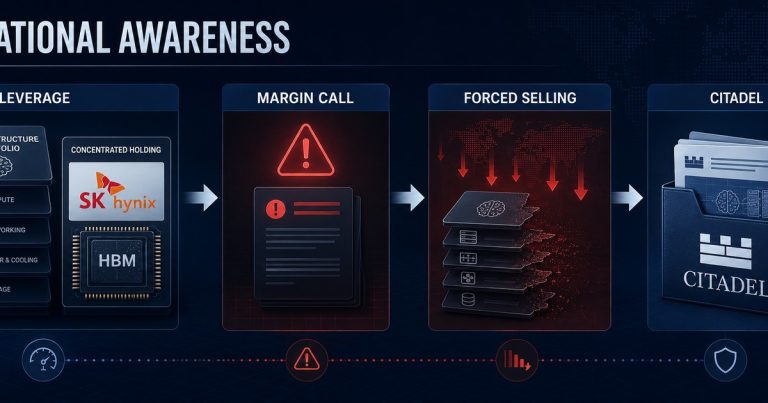
Leverage can add buying power during an advance, but it also raises the risk of collateral calls and forced selling when volatility returns. That makes a gap-up chase above 7,000 less attractive on a risk-adjusted basis. For the KOSPI outlook for August 18, even a positive trend should be weighed against leverage and closing confirmation rather than the first few minutes. A particularly fragile combination would be strong mega-cap chips, weak KOSDAQ and small-cap participation, and another rapid increase in margin debt.
U.S. semiconductor signals were mixed during the holiday
The external backdrop was not uniformly supportive. On August 14, the S&P 500 fell 0.17%, the Nasdaq declined 0.28%, and the Philadelphia Semiconductor Index slipped 0.31%. Weakness in selected semiconductor names, including Applied Materials and Broadcom, suggested that Korean chip investors would not receive a completely clean signal from Wall Street.
The tone improved before the U.S. regular session on August 17. Reuters reported higher S&P 500 and Nasdaq futures, while Micron, Broadcom and Nvidia traded higher before the open. That is encouraging for Korean memory sentiment, but premarket prices have thinner liquidity and can reverse during regular trading. The KOSPI outlook for August 18 should therefore be refreshed before Seoul opens using the actual U.S. close, the Philadelphia Semiconductor Index, Micron and Nvidia closing prices, Treasury yields and the won-dollar exchange rate. Premarket gains should never be converted mechanically into a forecast for Korean share returns.
Three scenarios for the August 18 session
| Scenario | Evidence | Interpretation |
|---|---|---|
| Durable breakout | Foreign cash buying persists, participation broadens, KOSPI closes above 7,000 | The rebound may be developing beyond a mega-cap chip trade |
| Intraday break and retreat | Only chips lead, foreign buying fades, close falls below 7,000 | Profit-taking and overhead supply remain substantial |
| Weak open and recovery | U.S. chip weakness is priced early, followed by foreign bargain buying | The intraday flow and close would be more constructive than the opening gap |
The useful sequence for the KOSPI outlook for August 18 is straightforward: persistent foreign buying, broader participation, and a closing hold above 7,000. One condition without the other two would argue for treating the session as part of a volatile rebound rather than a confirmed trend.
What international investors should monitor
Foreign investors should also distinguish index performance from currency-adjusted returns. A stronger KOSPI accompanied by a sharply weaker won may deliver a less impressive dollar return. Futures positioning can amplify the morning move, while cash-market buying provides better evidence that investors are building rather than briefly hedging exposure.
For context on how broad participation and foreign demand can improve the quality of a rebound, see the site’s earlier Korea stock market rally analysis. The same principle applies on August 18: the identity of buyers and the distribution of gains matter more than an isolated index milestone.
Conclusion: 7,000 is a verification zone, not a destination
The KOSPI outlook for August 18 contains both constructive and cautionary signals. Heavy foreign buying and four consecutive gains in Samsung Electronics and SK Hynix supported the August 14 rebound. At the same time, the rally has been fast, margin debt has increased, and the U.S. semiconductor backdrop has not moved in one clear direction.
Investors should therefore avoid treating 7,000 as a stand-alone buy signal. The more informative questions are who is buying, how far the money spreads, and whether demand survives through the closing auction. Foreign flow around 10 a.m. may provide the first answer. The final answer will come from the 3:30 p.m. close and the breadth of the market underneath it.
Sources
Index levels, investor flows and breadth are referenced against Korea Exchange market data; margin financing is referenced against Korea Financial Investment Association statistics; U.S. semiconductor conditions use U.S. index data and Reuters market reporting. Intraday and premarket values can change quickly and should be refreshed before any investment decision.
This article is for informational purposes only and does not constitute investment advice. Investment decisions and their consequences remain the responsibility of the investor. Verify the latest disclosures and market information before making any investment decision.