 Korean Stock Insight
SK Hynix ADR Premium: Why Samsung and Seoul Shares May Not Surge
The SK Hynix ADR premium can improve sentiment toward Korean semiconductor stocks, but it cannot guarantee that Samsung Electronics and SK Hynix will surge when Seoul opens. Strong overnight trading in SKHY gives Korean investors a useful signal about U.S. demand for AI memory exposure. Yet the U.S. ADR and the Korean common share trade at different hours, in different currencies, with different pools of investors and different settlement constraints. The better question is not whether Korea must copy Wall Street, but how the price gap will adjust and whether Korean short-selling and cash-market flows confirm the optimistic signal.
Why overnight ADR strength is not a guarantee
SKHY gives U.S. investors direct access to SK Hynix without opening a Korean brokerage account. During the early phase of a new listing, demand for a scarce, easy-to-trade AI-memory security can outrun the immediately available supply. The ADR price may therefore reflect the company’s long-term earnings outlook, but also an access premium, listing excitement and U.S.-specific positioning. The Korean common share, by contrast, is affected more directly by KOSPI flows, local leverage products, foreign futures and cash trading, won volatility and profit-taking by existing shareholders.
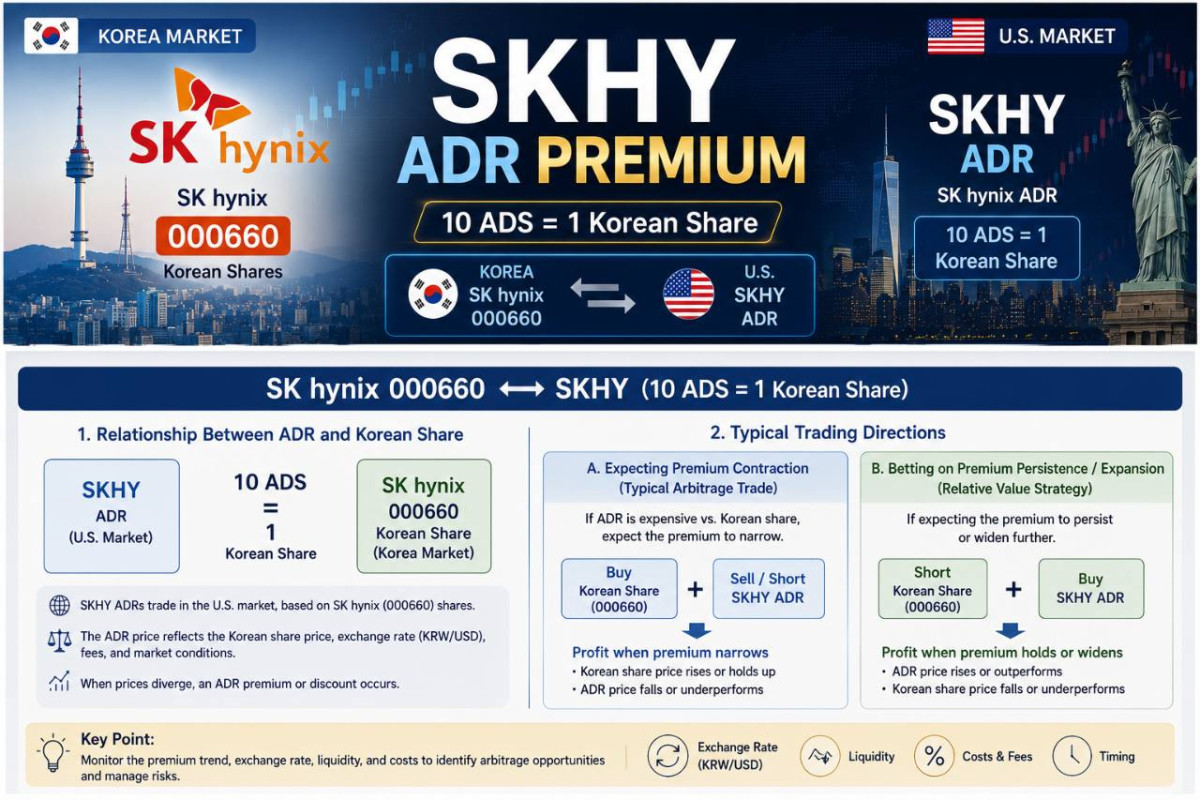
The SK Hynix Form F-6 filed with the SEC states that each ADS represents one-tenth of one Korean common share. Ten ADSs therefore correspond to one common share. That ratio creates an economic link, but it does not make the two securities identical at every moment. Seoul and New York do not normally trade simultaneously.
How to calculate the SK Hynix ADR premium
The SK Hynix ADR premium should be calculated only after matching the share ratio and currency. The basic parity formula is the SKHY price multiplied by ten and then multiplied by the USD/KRW exchange rate. That implied value can be compared with the nearest available price of the Korean common share. Every calculation should show the quote times because mixing a current U.S. price with a stale Korean close can make the gap look larger than it was when both markets last had a chance to react.
A large premium does not mean the Korean common share must rise by the same percentage. The spread can narrow through a rise in Seoul, a fall in SKHY, a change in USD/KRW, or all three. If limited ADR supply and initial excitement are the main causes, more of the adjustment may occur in the U.S. security. If the U.S. market is discovering a durable valuation for HBM leadership, the Korean share may absorb part of that signal. Investors can review the earlier SK Hynix ADR and Korean-share comparison for a worked example of the conversion formula.
The correct direction of an arbitrage trade
There is an important distinction between convergence arbitrage and a hedge. When the ADR is expensive relative to the Korean share, a textbook premium-convergence trade would sell or short the expensive ADR and buy the cheaper Korean common share. If operationally permitted, another route would be to purchase Korean shares, deposit them and receive ADSs that can be sold in the expensive market. Buying the premium ADR while shorting the discounted Korean share is the opposite exposure. It is a relative-value position that benefits if the ADR continues to outperform, or a hedge intended to reduce Korean-market exposure attached to an ADR holding. It is not the standard trade that profits when the premium disappears.
Real-world execution is more difficult than the textbook suggests. The SK Hynix deposit agreement requires documentation, approvals, fees and compliance with Korean law for deposits and ADS issuance. It also allows the depositary or the company to restrict, refuse or suspend deposits and issuance under specified conditions. Settlement delays, stock-borrow costs, foreign-exchange spreads, taxes, market holidays and operational access create additional friction. A visible premium can therefore persist even when professional investors recognize it.
What short-selling data can reveal
If the Korean share trades more weakly than overnight ADR sentiment implies, short-selling activity deserves attention. It should not, however, be treated as proof of a specific institutional ADR trade. Investors need to compare the daily short-sale value and ratio with recent averages, then examine securities-lending balances, new borrowing and returns, foreign cash flows and program trading. A lending balance indicates that shares are available for several strategies; it does not prove that every borrowed share has been sold short.
An SBS report citing Korea Exchange data said that Samsung Electronics and SK Hynix represented 38.9% of the total securities-lending balance on July 8. SK Hynix’s balance had increased by more than KRW 5 trillion from May 26. Those figures show that the capacity for bearish or hedged positioning had become unusually concentrated in the two chip leaders. They do not establish the cause of any single session. A more convincing bearish signal would be an above-normal short-sale ratio combined with rising lending balances and foreign cash selling. Falling balances, stock returns and sustained foreign buying would point in the opposite direction.
Why Samsung Electronics is different
Samsung Electronics does not have the same U.S. ADR setup as SK Hynix. Samsung’s official investor-relations listing page says its original shares trade on the Korea Exchange and its GDRs trade on the London Stock Exchange. Describing an overnight move as a Samsung U.S. ADR rally is therefore inaccurate. The relevant U.S. signals for Samsung are indirect: SKHY, Micron and semiconductor indexes. Its direct overseas depositary-receipt reference is the London-listed GDR.
The operating mix is also different. Samsung has memory, foundry, mobile devices, consumer electronics and other businesses, while SK Hynix offers a more concentrated AI-memory exposure. A high SK Hynix ADR premium may lift broad Korean chip sentiment, but it cannot be mechanically converted into a Samsung target price or expected daily return. Investors should separate a sector signal from a directly fungible price relationship.
Three scenarios for the Korean session
Strong upside
The SK Hynix ADR premium is validated when overnight strength is followed by sustained foreign cash buying, a stable short-sale ratio and a volume-backed rise in SK Hynix. The close matters more than an opening gap.
Limited gain or flat close
The opening reflects Wall Street, but Korean profit-taking caps the advance while SKHY gives back part of the SK Hynix ADR premium. The gap then narrows from both sides.
Unexpected weakness
Short-sale activity and foreign cash selling increase, local leveraged-product adjustments outweigh the positive U.S. signal, or investors decide that the early ADR scarcity premium is unsustainable. The Korean shares may then disappoint even while SKHY remains elevated. The previous Samsung and SK Hynix rebound analysis provides useful context on how institutional flows and earnings expectations can dominate a single headline.
Conclusion: watch the balance between two markets
The SK Hynix ADR premium is a positive sign of strong U.S. demand for HBM and AI-memory exposure. It can support Korean sentiment, but it does not dictate the next Seoul close. Trading-hour gaps, currency, available float, deposit restrictions, borrow costs and domestic market positioning all create friction between SKHY and the underlying common share.
The decisive evidence will come from how the SK Hynix ADR premium narrows and what Korean flows do at the same time. A rise in the Korean share accompanied by foreign buying and stable short selling would validate part of the U.S. signal. A falling ADR or increasing Korean short pressure would tell a different story. Samsung should be analyzed through its Korean shares, London GDR and broader semiconductor indicators rather than a nonexistent U.S. ADR. In short, the overnight rally is a useful input—not a guaranteed forecast.
Sources
This analysis uses the AP report on the SK Hynix ADR debut, SEC Form F-6 and deposit-agreement filings, Samsung Electronics’ official listing information and Korea Exchange lending data cited by SBS. Prices and short-selling figures can change quickly and should be refreshed before any investment decision.
This article is for informational purposes only and does not constitute investment advice. Investment decisions and their consequences remain the responsibility of the investor. Verify the latest disclosures and market information before making any investment decision.