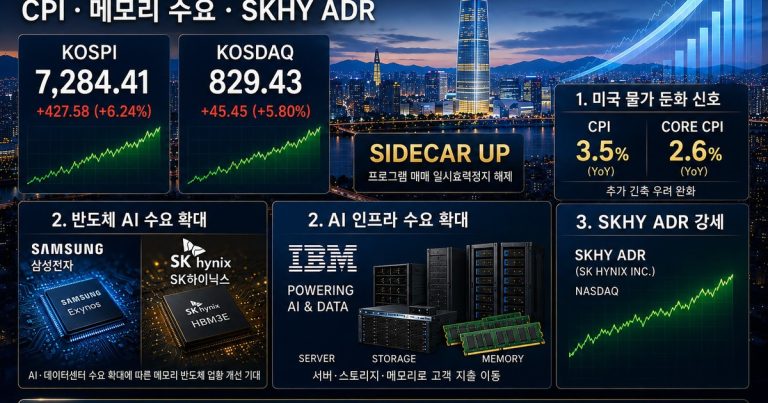
 Korean Stock Insight
KOSPI gives up its rally as KOSDAQ winners nearly match losers
The KOSPI held 5,000 on Monday, but investors who bought near the high ended the session 154.09 index points below their entry. The benchmark finished November 9 at 5,018.85, down 0.81%; the KOSDAQ lost 0.82% to 638.97. Nearly identical index returns concealed a difference that mattered to anyone picking individual Korean stocks.
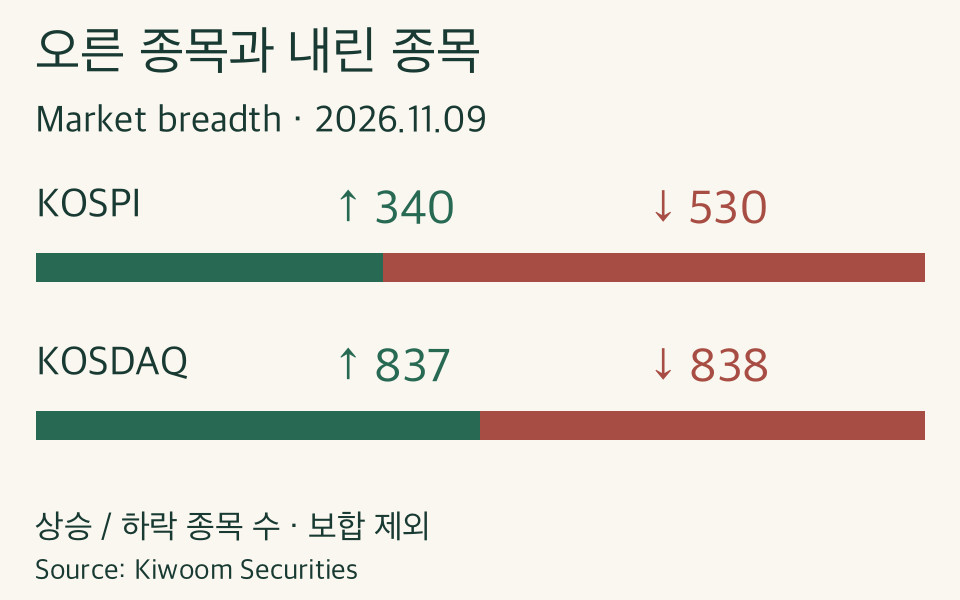
On the main board, 530 stocks fell and 340 rose. On the KOSDAQ the split was almost perfectly even: 838 decliners and 837 advancers. A capitalization-weighted index answers a different question from a count of stocks. The former measures what happened to the weighted portfolio; the latter shows how widely sellers prevailed. Smaller-company investors had plenty of winners to choose from, even though the index that tracks their market finished lower.
Friday’s KOSPI close of 5,059.69 helps put Monday’s reversal in perspective. The index traded as low as 4,990.66 and as high as 5,172.94. Around 11 a.m., institutions were net buyers and foreign investors were net sellers. Samsung Electronics was up more than 3% and SK hynix more than 4% at that point, following a recovery in US chip shares. Those were morning moves. The closing index tells us that the bid for memory stocks did not carry the wider market through the afternoon.

For chip suppliers, the distinction that matters now is between a shipment moving into a later quarter and a customer cutting its total order. Both can depress near-term earnings. Only the latter directly reduces the volume eventually delivered. A bounce after last week’s losses says little about which outcome customers are planning for. Delivery schedules would be more persuasive evidence than another strong opening hour.
Two KOSDAQ stocks illustrate just how different the news behind the same percentage gain can be. Network equipment supplier Mercury disclosed preliminary third-quarter consolidated revenue of KRW 38.235 billion and operating profit of KRW 3.96 billion, against a KRW 303 million operating loss a year earlier. That makes the quarter’s operating margin about 10.4%. Its shares were up 29.99% around 1:30 p.m. For investors assessing the fiber-optic business, the next useful comparison is whether subsequent deliveries sustain that margin.
Vaxcell-Bio was up 29.97% at about the same time. Its news came from an immuno-oncology conference: the company reported preclinical results for its dual-target CAR-T candidate VCB-1204 in a liver cancer animal model. Human safety and efficacy remain separate questions. Mercury shareholders will have another income statement against which to test their expectations; a meaningful milestone for Vaxcell-Bio would be a timetable for testing in people.
For Tuesday, a move back above Friday’s close would mean more if it lasted to the closing auction and came with more main-board advancers than decliners. Another morning surge in the two memory names alone would leave our assessment largely unchanged. A better close with broader participation would change it.
#KOSPI #KOSDAQ #Semiconductors #Mercury #VaxcellBio
This article is for information and does not recommend buying or selling securities.