 Korean Stock Insight
KOSPI Falls 1.24% as Samsung Expectations Reset and Selective Catalysts Stand Out
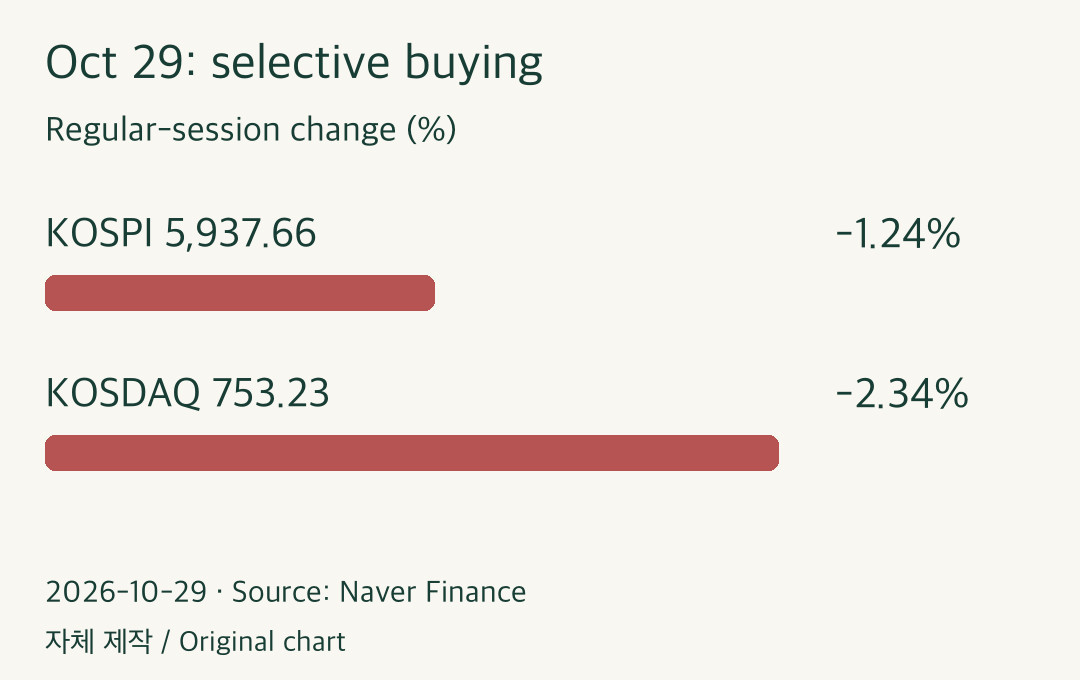
Korean equities gave back part of the previous session’s rally on October 29. The KOSPI closed at 5,937.66, down 1.24%, while the KOSDAQ fell 2.34% to 753.23. Our reading is that strong reported earnings faced an even more demanding expectations hurdle. Opportunities remained company-specific, with LED technology and Hanwha Vision’s profit improvement attracting attention in a broadly weak market.
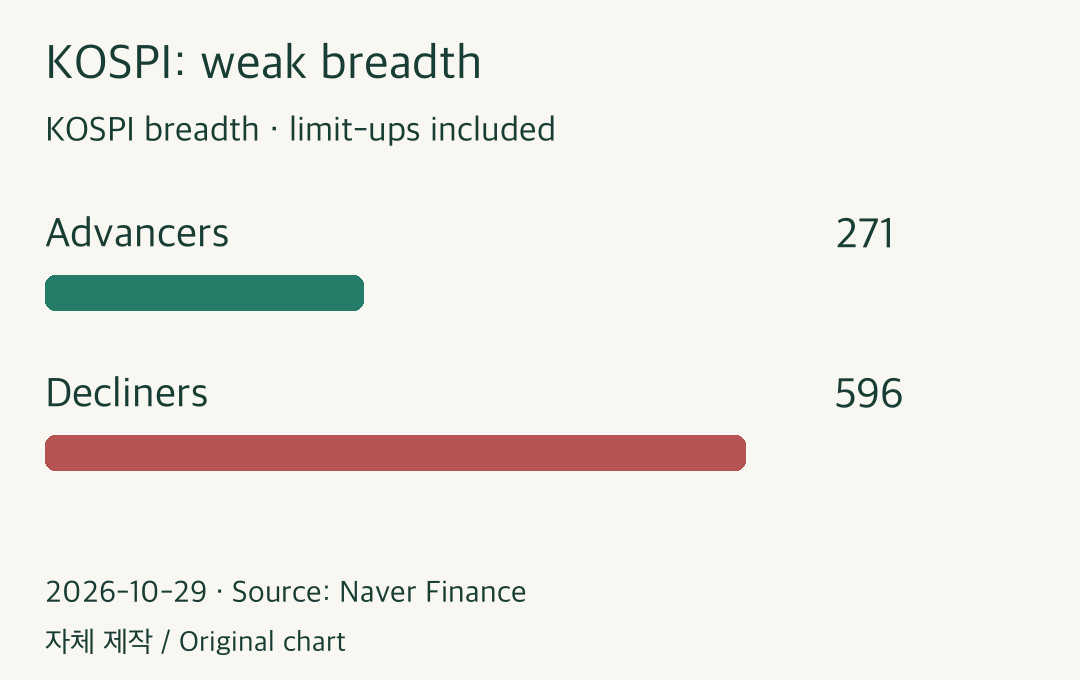
The main board traded between 6,100.11 and 5,817.92 before recovering part of its losses. Naver Finance counted 271 advancing KOSPI stocks, including the upper-limit stock, against 596 decliners. On KOSDAQ, the comparable counts were 339 and 1,326, including limit moves. A recovery from the day’s low therefore offered less reassurance than the headline index alone might suggest: participation remained narrow.
Overseas investors bought the main board on a net basis, while institutions sold. Both groups sold KOSDAQ. That split matters for investors deciding whether to broaden exposure beyond large companies. A rising index accompanied by persistent small-cap selling would still favor a selective approach in our view.
Samsung Electronics illustrated the gap between earnings and expectations. Yonhap reported preliminary third-quarter operating profit of roughly KRW107.4 trillion, a record, yet the shares traded at KRW229,500, down 5.17%, at 1:39 p.m. KST. This was an intraday observation. The report pointed to demanding earnings and shareholder-return expectations; we read the reaction as a reminder that the surprise relative to expectations can matter more than the absolute profit level.

Samsung announced a third-quarter cash dividend of KRW4,601 per share, totaling KRW30 trillion. Final decisions on the remaining return resources and execution are planned for its late-January 2027 board meeting. Cash distributions and future buybacks or cancellations should be valued according to their own timing. Execution can increase shareholders’ economic participation, but the valuation case also depends on how much of that benefit was already anticipated.
LED technology provided a different catalyst. MoneyToday reported that Seoul Viosys had developed WICOP3, a white-emitting LED technology without rare earths, with mass production planned for the fourth quarter. At 9:42 a.m., Seoul Viosys traded at KRW8,580, up 30.00%, and parent Seoul Semiconductor at KRW11,200, up 29.93%. These are intraday prices. Removing separate phosphor and packaging steps offers a potential manufacturing-cost and sourcing advantage.
The investment test for that technology is customer adoption at viable production yields. Delayed qualification or poor yields could postpone revenue and cost benefits even when the technical concept is promising. We would give greater weight to identified applications, shipment volumes and repeat orders than to a one-day price limit move.
Hanwha Vision offered evidence from an already reported quarter. Hansbiz reported preliminary consolidated revenue of KRW573.425 billion and operating profit of KRW102.572 billion, up 35.6% and 183.3% year on year. NewsTNT cited a KRX price of KRW44,000, up 9.45%, at 12:49 p.m., while the index was lower. Profit growing faster than sales makes the durability of that margin improvement the useful next question.
For the next session, we would track selling after Samsung’s announcement, concrete customer evidence for the LED production plan, and explanations for sustained profitability at Hanwha Vision. These represent different stages of the earnings process, so they warrant different tests. Broader participation would become more convincing if KOSDAQ foreign and institutional flows turn positive alongside an improvement in market breadth.
Sources: KOSPI regular-session close and breadth · KOSDAQ regular-session close and breadth · 삼성전자 실적 발표일 장중 주가 반응 · 삼성전자 2026년 3분기 실적 발표 · 서울바이오시스·서울반도체 LED 개발과 장중 반응 · 한화비전 3분기 잠정 실적 · 한화비전 실적 발표 후 장중 상승
#KOSPI #KOSDAQ #Samsung #LED #HanwhaVision
This article is for informational purposes and is not a recommendation to buy or sell securities. Investors are responsible for their decisions and any gains or losses.