 Korean Stock Insight
KOSPI Close on August 18: Why 7,216 Turned Into a 6,869 Finish
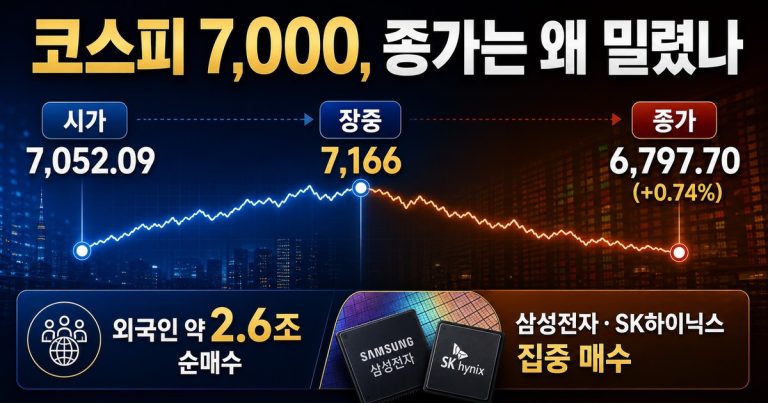
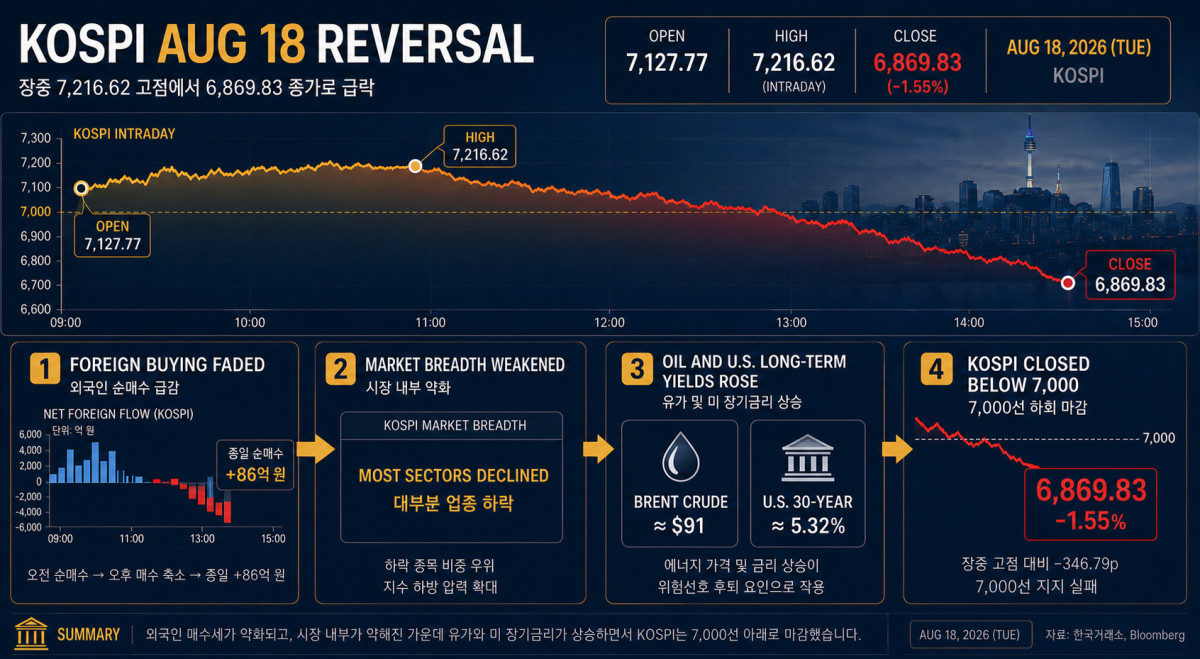
The KOSPI close on August 18 offered a sharp lesson in why an intraday high can matter less than the money left at the end of the session. The index opened at 7,127.77 and climbed to 7,216.62, briefly making a sustained move above 7,000 look plausible. By the closing bell, however, the KOSPI had reversed to 6,869.83, down 1.55%. The important question is not simply why the index finished at 6,869. It is why the buying power visible in the morning failed to remain through the afternoon.
KOSPI close on August 18: grading the three tests
The previous outlook proposed three tests for believing a KOSPI breakout above 7,000: continued foreign buying, broader strength beyond Samsung Electronics and SK Hynix, and a close above 7,000. Using the session figures reported through the Korea Exchange market-data portal, the first test earned only a partial pass while the other two failed.
| Test | August 18 result | Grade |
|---|---|---|
| Foreign flows | More than KRW 1 trillion net buying early, about KRW 86 billion by the close | Partial |
| Market breadth | Most sectors declined | Fail |
| Close above 7,000 | 6,869.83 | Fail |
The intraday print above 7,200 was visually impressive, but it did not prove that investors were willing to absorb supply at that level. The afternoon loss of momentum carried more information than the morning headline.
Why the KOSPI fell despite net foreign buying
Foreign investors bought more than KRW 1 trillion of KOSPI shares early in the day and helped push the index to its high. The final flow picture was much less powerful: foreigners were net buyers by about KRW 86 billion, individuals bought about KRW 731.2 billion, and institutions sold about KRW 784.9 billion. Foreign demand remained positive in sign, but most of its early intensity disappeared.
This distinction is essential when interpreting the KOSPI close on August 18. A positive final number does not tell investors whether foreign buyers kept adding near the high, whether futures confirmed the cash-market demand, or whether purchases were concentrated in a handful of names. As institutional selling continued and individuals absorbed the supply, the market lost the support needed to hold 7,000.
Weak market breadth exposed the rally’s narrow base
For the KOSPI close on August 18, market breadth was more troubling than the headline flow figure. IT services fell by more than 5%, securities firms lost more than 4%, and machinery, transportation equipment and construction declined by more than 3%. Insurance and transportation and warehousing were among the limited areas that held up relatively well.
A durable KOSPI move above 7,000 requires profits and fresh capital to spread from semiconductors into autos, shipbuilding, power equipment, financials, healthcare and smaller companies. That did not happen. Weak groups started to break first, and the index followed as large-cap momentum faded. The next rebound should be judged by advancing stocks, KOSDAQ participation and trading-value expansion outside chips.
Samsung Electronics and SK Hynix sent different signals
Samsung Electronics ended at KRW 268,500, down 2.19%, while SK Hynix held a gain of about 1.03% near KRW 1.66 million. SK Hynix’s positive finish suggests that enthusiasm for HBM demand has not disappeared. Yet the joint leadership structure broke when Samsung fell.
For another credible attempt at KOSPI 7,000, investors should watch whether Samsung rejoins SK Hynix. They should also examine whether foreign cash buying survives into the close and whether volume can absorb profit-taking. One resilient chip stock can cushion the index, but it is unlikely to carry the entire market for long.
Oil and U.S. long-term yields raised the discount rate
The reversal cannot be explained only as profit-taking. Renewed tension surrounding the U.S.-Iran conflict and possible disruption around the Strait of Hormuz lifted reported Brent crude to around $91 per barrel. The U.S. 30-year Treasury yield moved near 5.32%, with the 10-year yield in the 4.7% area. Confirm the latest oil level in the U.S. Energy Information Administration’s spot-price data and yields in the U.S. Treasury’s daily curve table.
This was central to the KOSPI close on August 18: geopolitical escalation raised supply concerns, higher oil revived inflation risk, and rising long-term yields increased the discount rate applied to growth stocks. Semiconductor fundamentals did not need to collapse for AI shares to face valuation pressure. Korea may have priced part of that risk before New York opened.
Three signals to watch in the U.S. session
Premarket futures are useful but unstable. Broad coverage from Reuters Markets should be read with regular-session prices. The first signal is oil: does Brent settle near the low $90s, or accelerate higher? A renewed spike would encourage investors to treat the conflict as an inflation shock rather than a short-lived headline.
The second signal is the U.S. yield curve. Stocks may absorb expensive oil if 10-year and 30-year yields stabilize. If oil and yields rise together, highly valued companies face a higher discount rate. The third signal is U.S. semiconductors. The ability of Nvidia, Micron and the Philadelphia Semiconductor Index to recover will influence the next Korean session.
If U.S. markets absorb the shock, the interpretation changes
If Brent remains above $90 but long-term yields stabilize and the Nasdaq and chip shares recover, the Korean decline may have over-discounted the external risk. Foreign investors could then return as bargain hunters.
If oil rises again, Treasury yields climb and U.S. semiconductor shares fall together, another KOSPI 7,000 test may be delayed. Stabilization in the 6,800 area and evidence that foreign selling remains contained would matter more than a quick attempt to reclaim the round number.
Scenarios for the next Korean session
| Scenario | Signals | Interpretation |
|---|---|---|
| Shock absorbed | Oil stabilizes, long yields ease, Nasdaq and chips recover | Korea may have priced the risk early |
| Volatility persists | Oil stays high while yields and chips are mixed | The 6,800-7,000 range remains a supply-absorption zone |
| Risk expands | Oil and yields rise together as U.S. chips fall | Support near 6,800 matters before another 7,000 test |
The KOSPI close on August 18 suggests a practical sequence: foreign cash flow, Samsung’s participation, advancing stocks and the final hour. A strong opening should not be chased automatically. If foreign buying fades while breadth stays narrow, the reversal can repeat.
Conclusion: the money that remains matters more than the high
The KOSPI close on August 18 should be remembered for the transition from 7,216.62 to 6,869.83, not merely for another dramatic intraday high. Foreign investors finished as net buyers, but the early force faded. Market breadth failed, the close fell below 7,000, and Samsung Electronics did not confirm SK Hynix’s resilience.
The broader KOSPI 7,000 thesis does not need to be abandoned, but its next direction may be set first by oil, U.S. long-term yields and American semiconductor trading. The central lesson from the KOSPI close on August 18 is simple: the money willing to remain at elevated prices matters more than the highest number printed during the morning.
This article is for informational purposes only and does not constitute investment advice. Investment decisions and their consequences remain the responsibility of the investor. Verify the latest disclosures and market information before making any investment decision.