 Korean Stock Insight
[July 29]Korea Stock Market Wrap
This Korea stock market wrap examines five important signals from the July 29, 2026 rout. Korean equities extended the previous session’s historic decline as semiconductor weakness, leveraged-position unwinds, and caution ahead of the Federal Reserve decision kept investors firmly in risk-off mode.
Yet the session was not completely one-sided. Robotics, actuator suppliers, K-beauty, food exporters, oil-related shares, and selected AI companies attracted capital. The index was still falling down the stairs, but a few sectors had already found the emergency handrail.
1. KOSPI and KOSDAQ Extended the Selloff
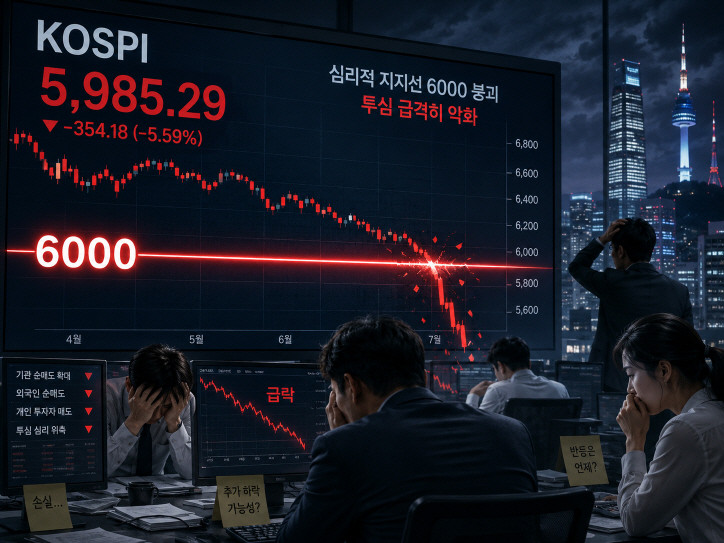
The KOSPI closed at 5,663.24, down 5.98%, while the KOSDAQ fell 6.12% to 662.68. Both indices experienced another highly volatile session as forced selling and market-stabilization mechanisms remained part of the trading landscape.
The latest decline followed the much steeper July 28 crash. Readers can review the previous Korea stock market wrap for July 28 to understand how the semiconductor-led correction developed into a broader liquidity event.
2. Record Earnings Could Not Save Semiconductors
SK hynix dropped 9.61%, even after reporting record second-quarter operating profit and exceptionally strong profitability. Samsung Electronics also declined 5.23%.
The reaction showed that earnings alone were no longer setting prices. Investors were focused on global chip de-risking, the Federal Reserve, crowded leverage, and the possibility that optimistic AI expectations had already been reflected in valuations.
3. Physical AI and Robotics Became the Main Rotation
Robotics was the clearest pocket of strength. Angel Robotics surged 29.87% after unveiling FACT, an actuator module designed for physical-AI robots. The announcement strengthened interest in companies supplying the motors, reducers, controllers, and automation systems needed to make intelligent robots move in the real world.
- TXR Robotics +24.62% — continued robotics and automation momentum
- SPG +20.29% — expectations for robot-actuator mass production
- Now Robotics +18.33% — North American expansion and industrial-robot exposure
- Hyundai Movex +12.47% — smart logistics and factory-automation demand
The robotics rally was supported by specific products and capacity plans rather than a vague futuristic story. That distinction helped the group attract speculative capital despite severe weakness in the broader market.
4. Consumer Defensives Offered Selective Shelter
Investors also rotated toward businesses with export growth and relatively visible earnings. Genic gained 6.33%, PharmaResearch rose 4.13%, and LG H&H advanced 2.94% as Brazil-related K-beauty expansion drew attention.
Samyang Foods increased 3.13%, supported by overseas sales expectations and additional production capacity. These stocks were not traditional low-volatility utilities, but their consumer demand and export earnings gave investors something the chip sector lacked that day: visibility.
5. Oil and AI Advertising Added Event-Driven Strength
Heungkuk Oil gained 5.21% as international crude prices rebounded. Madup jumped 29.82% after strong first-half profit growth highlighted the monetization potential of AI-powered advertising technology.
For wider context on the historic Korean equity-market decline and the role of semiconductor weakness and leveraged trading, read the Reuters report on the July 29 Korean market rout .