 Korean Stock Insight
What Is a Private Fund of Funds? Why Korean Investors Are Paying Attention
A private fund of funds is moving back into the center of Korea’s wealth-management conversation. Exchange-traded funds are liquid and inexpensive, but an equity ETF usually passes a broad market decline directly to the investor. Bank deposits are stable, but their return potential is limited. Between those choices, many investors are asking whether professional strategies can be combined to pursue returns with less dependence on the direction of the KOSPI. Korea’s publicly offered private fund-of-funds products are designed for that purpose. The name can be confusing: an individual is not directly subscribing to a private fund, and the product is not an ETF that trades intraday. Understanding the two-layer structure is the first step toward evaluating both the opportunity and the risk.
Why private fund-of-funds products are attracting attention
Two developments are occurring at the same time. First, sharp moves in Korean equities have reminded investors that a portfolio dominated by stocks and equity ETFs can have only one major source of risk. Second, asset managers and securities firms are introducing more public funds that package private long-short and multi-strategy funds for retail clients. In June 2026, TIMEFOLIO said the assets under management of its With Time product had exceeded KRW 1 trillion, the first Korean public private-fund-of-funds product to reach that level. The manager’s announcement is useful evidence of investor demand, although its performance claims should not be treated as a forecast.
Product supply is also expanding. A July 2026 report on a newly distributed fund described a public vehicle that diversifies across domestic and overseas equity long-short and multi-strategy private funds. The trend does not mean that every product is attractive. It means that investors now have more access to strategies that were once concentrated among high-net-worth or professional clients, making careful comparison more important.
How a private fund of funds works
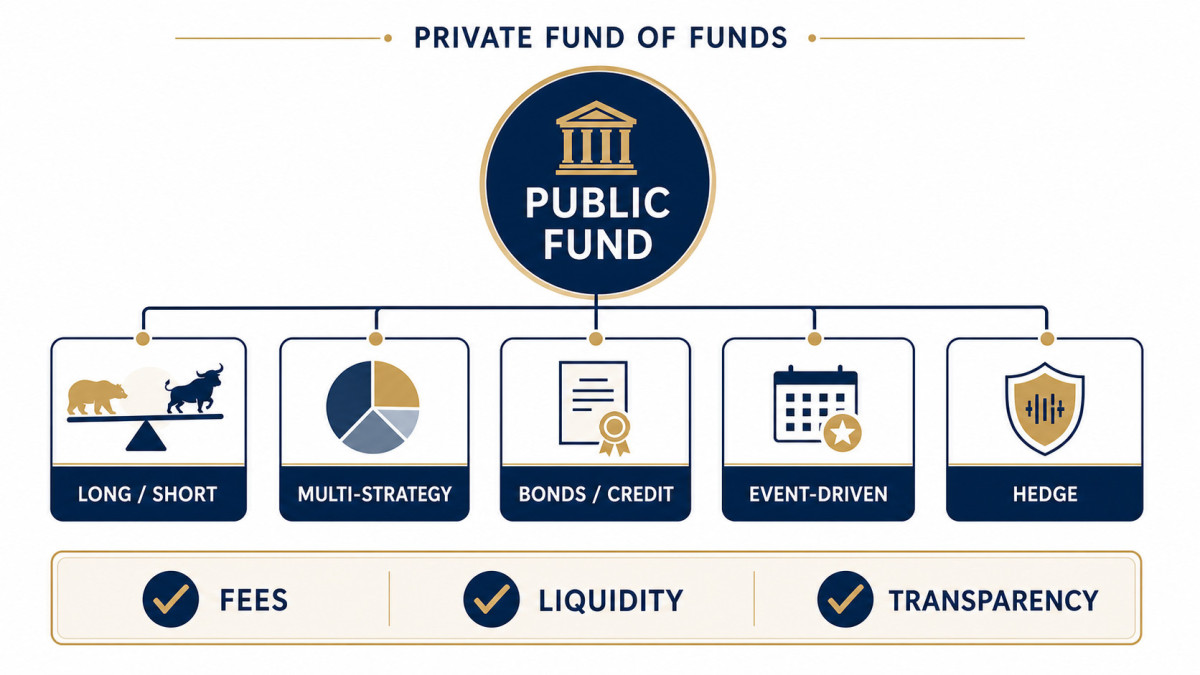
A private fund of funds is, literally, a fund that owns other funds. The investor buys units of a publicly offered Korean fund through a distributor. That public fund then buys units in several qualifying general private funds. The Korea Financial Investment Association describes the category as a public fund that invests indirectly in general private funds. Under the relevant Korean rules, a private-investment fund-of-funds vehicle is defined by investing more than 50% of its assets in qualifying general private funds or comparable foreign vehicles. The detailed statutory language is available through the Korean capital-markets enforcement decree.
The simplified chain is: retail investor, public fund, underlying private funds, and finally securities or strategies such as stocks, bonds, convertibles and derivatives. An underlying manager may run Korean or global equity long-short, global macro, event-driven, credit, mezzanine or IPO-related strategies. The number of underlying funds, allocation ranges and rebalancing process vary widely by product. Two funds carrying the same regulatory label can therefore have very different risk, liquidity and return patterns.
What absolute return really means
Marketing material often uses the phrase absolute return. It does not mean that a private fund of funds cannot lose money. It normally means that the managers seek positive returns with less reliance on whether a stock index rises or falls. An equity long-short fund can buy companies it views as attractive and sell short companies it expects to underperform, reducing net market exposure. An event-driven fund may focus on mergers, capital raising or corporate restructuring. A credit strategy may seek opportunities created by changes in interest rates or credit spreads.
Each approach introduces its own risks. A short position loses money when the price rises instead of falls. Mezzanine and other less-liquid assets can be difficult to value or sell. Macro trades can suffer when policy or currency moves surprise the manager. Combining strategies changes the sources of risk; it does not eliminate risk. “Potentially less sensitive to the KOSPI” and “principal protected” are completely different statements.
Three potential advantages
Access to specialist managers
The public wrapper can provide indirect access to private strategies that may otherwise have high minimum subscriptions or limited capacity. The exact minimum investment still depends on the share class and distributor, but the access barrier is generally lower than a direct private-fund subscription.
Diversification across managers and strategies
A portfolio of several underlying funds can reduce dependence on one manager’s security selection or one asset class. Weak equity long-short results might be partly offset by credit or event-driven exposure. Investors must nevertheless examine the actual allocation. Owning seven funds is not meaningful diversification if most of them hold the same large-cap stocks or depend on the same market event.
A different return source
If the underlying funds actively control net equity exposure and use hedges, the product may experience smaller losses than a fully invested equity fund during some market declines. That can add a differentiated return source to a stock-heavy portfolio. The benefit is only a possibility, not a promise, and should be evaluated through drawdown, volatility and recovery data rather than the product’s name.
Private fund of funds risks investors should not overlook
Costs come first. The public fund has its own management, sales and administration charges, while the underlying private funds may charge management and performance fees. Investors should look beyond the headline expense ratio and find the combined or synthetic total cost disclosed in the prospectus. A strategy must generate enough gross alpha to overcome both layers.
Liquidity is the second issue. A public fund is not automatically cash-like. The underlying private funds may calculate net asset value less frequently or require longer notice for redemptions. As a result, some Korean private fund-of-funds products can take many business days to pay redemption proceeds. Cutoff time, applied valuation date and payment date must be checked for the specific share class. Emergency cash and near-term spending money do not belong in a product with a long redemption cycle.
Transparency is another trade-off. Public funds provide prospectuses and periodic reports, but the underlying private funds may not disclose positions every day. Investors can face a delay in understanding concentration, leverage or changing exposures. Manager-selection risk also matters: past success can fade when the market regime changes or key professionals leave. Finally, apparent diversification may hide overlapping positions. The count of funds is less important than the economic risks they share.
Who may find the structure suitable
A private fund of funds may suit an investor who already has substantial equity and ETF exposure and wants a return source with potentially lower market correlation. It may also suit someone with a multi-year horizon who can evaluate a manager’s process, tolerate periods of underperformance and wait through a longer redemption schedule. The goal should be portfolio diversification, not a quick substitute for a winning stock trade.
The structure may be unsuitable for short-term traders, investors who require daily portfolio transparency, people who are highly sensitive to layered fees, or anyone who cannot accept investment losses. It is also unsuitable for cash that may be needed quickly. A product designed to be “less volatile” is not the same as a deposit that can be withdrawn at principal value.
A private fund of funds checklist before investing
- How many underlying private funds are held, and what share is concentrated in the top three?
- What is the real allocation to equity long-short, multi-strategy, credit, event-driven and cash-management strategies?
- What are the target net equity exposure and volatility range?
- What is the combined cost after including underlying-fund fees and performance fees?
- What are the redemption cutoff, valuation date and payment date?
- What were the maximum drawdown and recovery period, and which market conditions produced losses?
- Can the product soft-close, restrict new subscriptions or change distributors?
Read the prospectus sections on investment strategy, principal risks, fees and redemption before looking at the latest return. Investors should distinguish returns generated by market beta from returns generated by security selection, hedging or leverage. A sophisticated label does not remove the need for basic due diligence.
What comes next in this series
This first article established the common framework for evaluating a private fund of funds. The second installment will examine TIMEFOLIO With Time: the underlying hedge-fund strategies, the reasons its assets grew beyond KRW 1 trillion, its redemption timetable, expenses and the type of investor who may find the product suitable. Later articles will apply the same checklist to Daol Orca Alpha Selection, MUST One & Only and iM Asset Hero Selection so that differences in manager selection, liquidity and portfolio design remain visible.
This article is for informational purposes only and does not constitute investment advice. Investment decisions and their consequences remain the responsibility of the investor. Verify the latest disclosures and market information before making any investment decision.