 Korean Stock Insight
Samsung and SK Hynix Selloff: 3 Forces Behind Korea’s Market Crash
The Samsung and SK Hynix selloff drove an extraordinary decline in South Korea on July 13, 2026. The KOSPI closed 8.95% lower at 6,806.93 after a market-wide circuit breaker, while Samsung Electronics fell by more than 10% and SK Hynix by more than 15%. Tensions involving the United States, Iran and the Strait of Hormuz clearly raised risk aversion, oil-price concerns and bond yields. Yet geopolitics alone does not explain why Korea underperformed so severely. Japan also traded lower, so the claim that neighboring markets all rose is not supported by the available evidence. Korea’s distinctive pressure came from elevated chip-earnings expectations, leveraged-product flows and anxiety about financing AI infrastructure.
Samsung and SK Hynix selloff: what happened today
Foreign and institutional investors were reported to have sold roughly KRW 1.7 trillion and KRW 2.5 trillion, respectively, in the KOSPI electrical and electronics sector, while individuals bought about KRW 4.2 trillion. Both chip leaders are now more than 30% below recent highs. A drawdown of that scale reduces some valuation pressure, but it does not identify a bottom. The identity of sellers, the pace of estimate revisions and the market’s ability to absorb forced liquidation matter more than the percentage decline alone.
Hormuz risk remains relevant because an oil shock can lift inflation expectations and long-term rates. Higher yields are particularly painful for growth stocks whose valuations depend on profits far in the future. The better interpretation is therefore not that geopolitics was irrelevant, but that a global risk shock met an unusually concentrated Korean index and a highly leveraged semiconductor trade.
First driver: SK Hynix earnings expectations reset
A Korean brokerage estimate provided the most direct catalyst. Korea Investment & Securities analyst Chae Min-sook was reported to forecast SK Hynix second-quarter operating profit of KRW 60.4 trillion, about 8% below the market consensus near KRW 65 trillion. That is not a weak absolute profit figure. The problem is the gap between an excellent business result and an even more demanding market expectation after a powerful AI-memory rally.
Semiconductor shares respond to changes in future profit growth rather than the current quarter alone. HBM pricing, customer qualification, production yield and conventional DRAM supply can all move forecasts quickly. The Samsung and SK Hynix selloff should therefore be viewed as an expectations shock unless company results and guidance confirm a deeper deterioration. Investors need to watch whether analysts continue lowering estimates or whether official disclosures defend the current earnings cycle.
Samsung and SK Hynix also have different earnings mixes. HBM leadership, commodity memory exposure, foundry execution and customer concentration are not identical. Treating both stocks as one AI trade can intensify correlation during a selloff even when their operating drivers differ.
Second driver: single-stock leverage and forced-flow fears
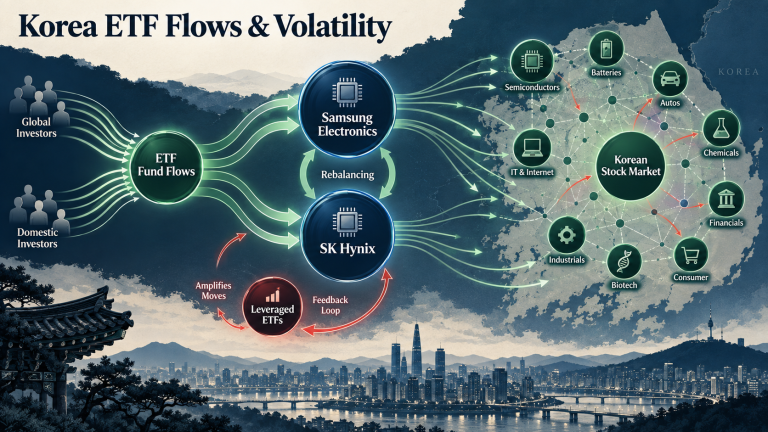
Korea introduced single-stock leveraged ETFs and ETNs tied to Samsung Electronics and SK Hynix in May. The Financial Services Commission warned that these products target multiples of daily returns, lack diversification and can suffer amplified losses and negative compounding. When the underlying shares fall sharply, leveraged products decline even more, potentially triggering redemptions, stop-loss orders, margin pressure and hedge adjustments.
However, claims that the products are definitely being delisted and that managers must therefore dump the underlying shares have not been confirmed by an official FSC, Korea Exchange or asset-manager announcement. The delisting story should be labeled an unverified rumor, not a proven cause. Cash-based and futures-based products also hedge differently, so it is inaccurate to assume that every product sells the same quantity of common stock.
The mechanism can still matter without a delisting. Heavy losses, margin calls and derivatives rebalancing can reinforce a decline in a concentrated market. The Samsung and SK Hynix selloff illustrates how leverage can transform an earnings disappointment into a broader liquidity event. Confirmation requires product-level assets, redemption data, futures positioning and official notices rather than social-media claims.
Third driver: Oracle credit risk and AI funding anxiety
The market also connected Oracle’s credit pressure with the sustainability of AI infrastructure spending. S&P was reported to have lowered Oracle’s issuer rating to BBB-, the lowest investment-grade level. Earlier S&P analysis had already highlighted widening free cash flow deficits, increasing leverage and material credit risk from aggressive data-center investment. Oracle itself announced a 2026 financing plan using equity, equity-like securities and investment-grade bonds to fund the expansion of Oracle Cloud Infrastructure.
Oracle matters because it turns an abstract AI-capex debate into a balance-sheet question. Data centers require enormous upfront spending on chips, networking, buildings, electricity and cooling before contracted revenue is fully realized. Higher oil prices and Treasury yields can increase both operating and financing costs. Investors then ask whether hyperscalers and cloud providers will slow projects, which would eventually affect HBM and server-memory demand.
That concern is legitimate, but a downgrade does not mean that Oracle has stopped investing or lost access to capital. The company has reported strong cloud demand and a large contract backlog. Credit pressure signals that financing is becoming more expensive and execution matters more; it does not by itself prove that the AI investment cycle is ending.
A fundamental collapse or a collision of expectations and flows?
Samsung Electronics and SK Hynix did not lose their manufacturing technology, customer relationships or production assets in one day. A more balanced explanation is that high earnings expectations met a lower forecast, leveraged flows accelerated selling, and Oracle credit concerns plus geopolitical risks raised the discount rate. The Samsung and SK Hynix selloff demonstrates how a fundamentally profitable industry can still experience a liquidity shock when positioning is crowded.
That conclusion is not an automatic buy-the-dip call. If earnings estimates continue to fall, fair values can decline even after a 30% correction. Conversely, if estimates stabilize, foreign selling slows and long-term yields retreat, the move may later look like an overshoot caused by sentiment and forced flows.
Five conditions that could stabilize Korean chips
- SK Hynix reports earnings and HBM profitability that defend the cycle.
- Samsung maintains its memory pricing and HBM customer-qualification roadmap.
- Foreign and institutional selling in electrical and electronics stocks slows.
- Regulators, the exchange and managers clarify the status of single-stock leveraged products.
- U.S. long-term yields and oil stabilize while big-tech capital-spending plans remain intact.
A lasting rebound probably requires improvement in at least two of the three major pillars: earnings, flows and rates. A sharp intraday bounce is less convincing than a stable close, lower volatility and follow-through in foreign demand.
What investors should monitor next
Investors should separate verified data from rumors. Official company guidance deserves more weight than brokerage summaries, and regulator or exchange notices deserve more weight than claims about forced delisting. For broader context, see the site’s Korea weekly market outlook and SK Hynix ADR premium analysis.
The next confirmation points are SK Hynix’s earnings release, Samsung’s HBM progress, foreign net flows, single-stock product disclosures, U.S. Treasury yields, oil and hyperscaler capex guidance. Together they will show whether the market is repricing a real earnings slowdown or merely clearing crowded positions.
Conclusion: three forces, not one headline
The Samsung and SK Hynix selloff did not have one true cause. A reset in profit expectations, leveraged-flow anxiety, Oracle credit and AI-financing concerns, and geopolitical pressure arrived together. The delisting rumor remains unverified and should not be presented as fact. The next move will depend less on a single Hormuz headline than on earnings revisions, official leveraged-product announcements, foreign flows, long-term yields and big-tech AI spending.
Sources
This analysis uses the Hankyoreh market close report, Seoul Shinmun market and earnings report, the FSC single-stock leveraged-product warning, S&P Global Ratings analysis of Oracle financing, and Oracle’s official 2026 financing plan.
This article is for informational purposes only and does not constitute investment advice. Investment decisions and their consequences remain the responsibility of the investor. Verify the latest disclosures and market information before making any investment decision.