Korea Market Wrap: KOSPI Falls, KOSDAQ Rises as AI Infrastructure Themes Take Over
Date: July 1, 2026
Focus Keywords: Korea stock market, KOSPI, KOSDAQ, AI semiconductor stocks, MLCC, PCB, power infrastructure, Korean energy stocks
Market Snapshot
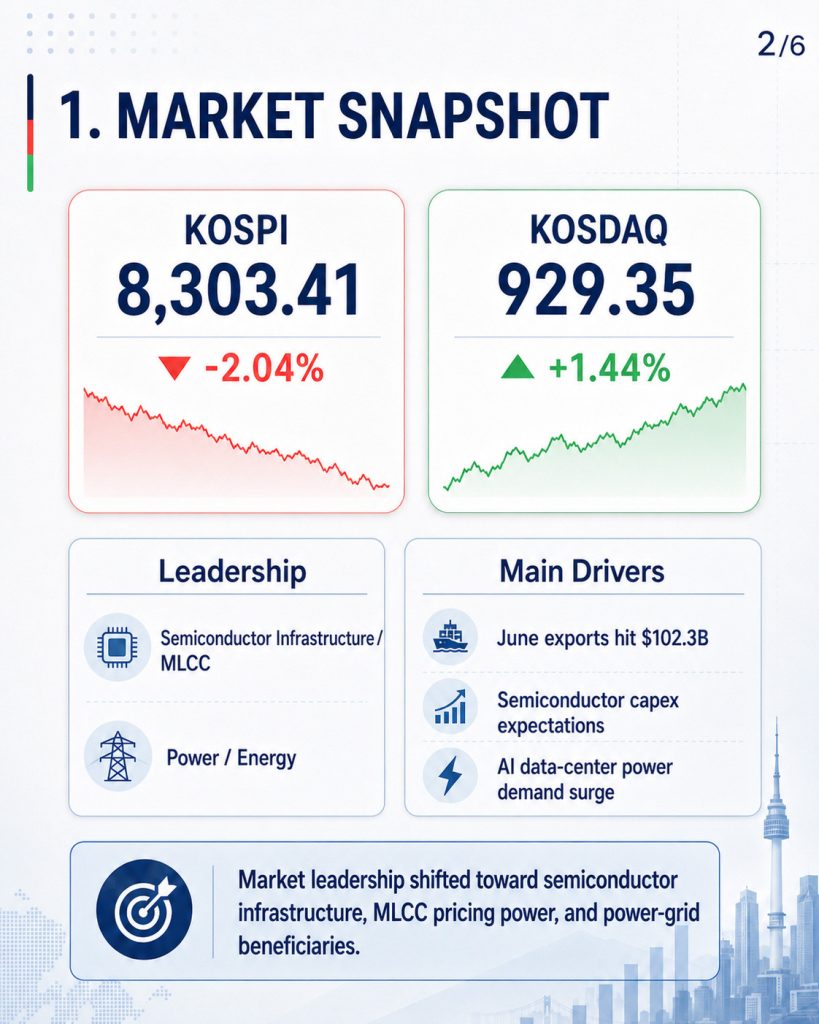
The Korean stock market delivered a sharply divided session on July 1, 2026. The KOSPI closed at 8,303.41, down 2.04%, pressured by weakness in mega-cap semiconductor names. In contrast, the KOSDAQ climbed to 929.35, up 1.44%, showing that investor appetite did not disappear; it simply moved elsewhere. Today’s tape was less about broad market strength and more about selective rotation into smaller and mid-cap names tied to semiconductor infrastructure, MLCC pricing power, PCB demand, power grids, emergency power systems, and AI data-center construction.
Semiconductors: Mega-Caps Fell, Supply Chain Winners Rose
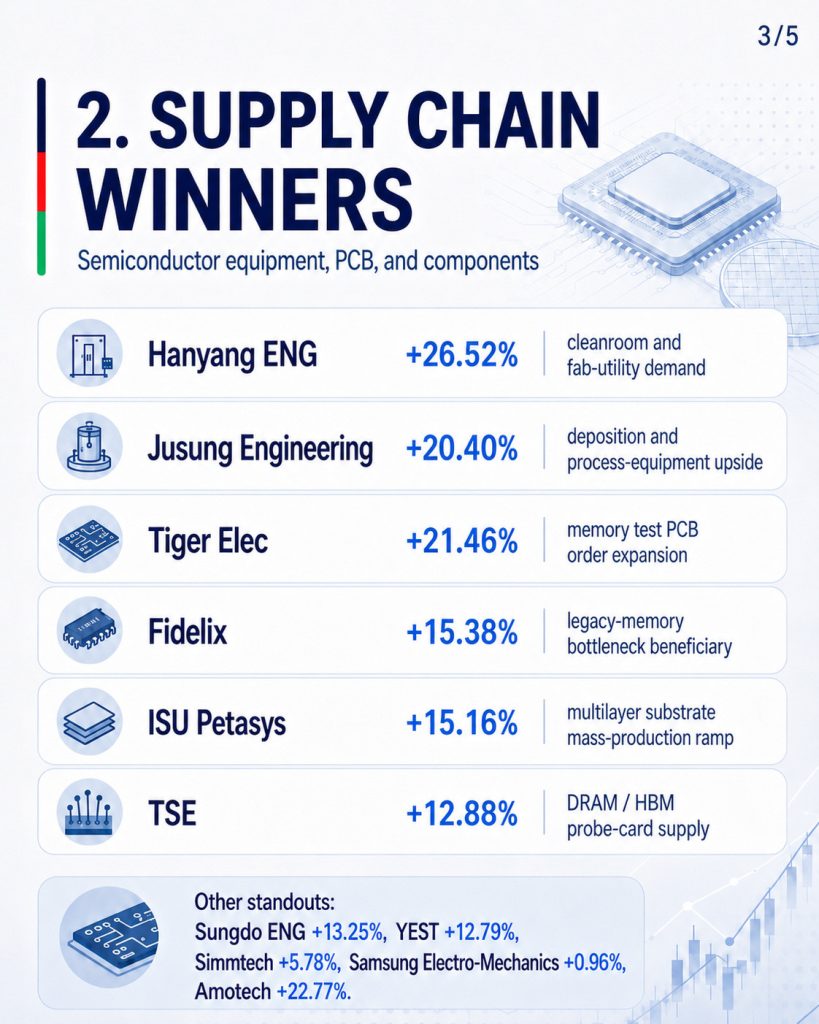
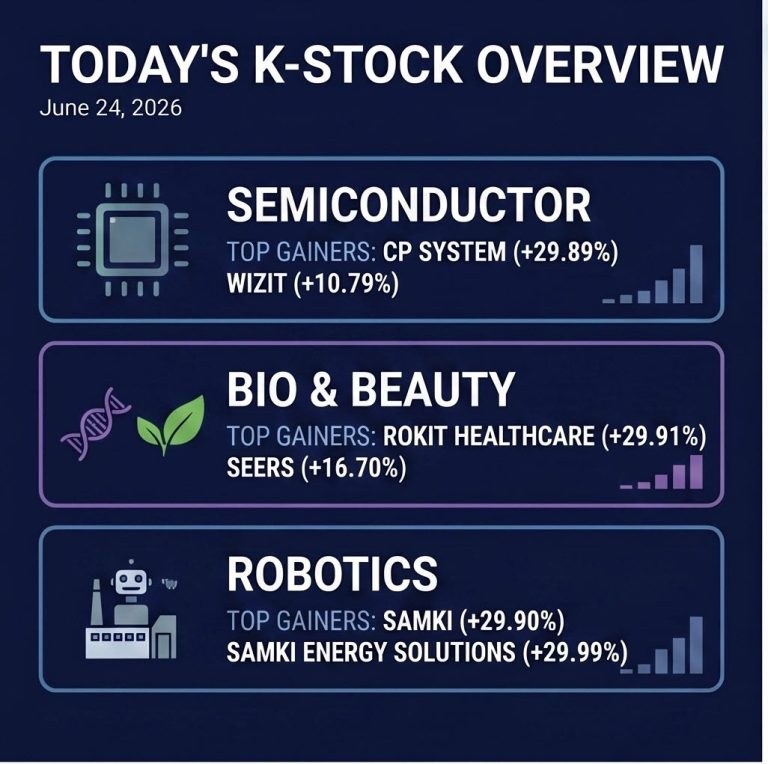
Samsung Electronics fell 5.84% and SK hynix declined 3.40%, dragging the KOSPI lower. However, this was not a simple “semiconductor sell-off.” Beneath the index weakness, semiconductor infrastructure names showed powerful momentum. Hanyang ENG jumped 26.52%, Jusung Engineering gained 20.40%, Tiger Elec rose 21.46%, Fidelix advanced 15.38%, ISU Petasys added 15.16%, and TSE climbed 12.88%.
The key market message was clear: investors are rotating from pure memory-chip exposure into the broader AI semiconductor value chain. Cleanrooms, fab utilities, deposition equipment, test PCBs, multilayer substrates, and HBM probe-card suppliers all attracted attention. In other words, the market is asking a very practical question: “Who gets paid when new fabs, AI servers, and advanced memory lines actually get built?”
MLCC and PCB: Pricing Power Becomes the Star
MLCC and PCB-related stocks remained a major focus. AI servers require higher-performance components, denser substrates, more stable power delivery, and advanced packaging support. That explains why investors paid attention to names such as Samsung Electro-Mechanics, Amotech, Simmtech, and ISU Petasys. The MLCC cycle is being supported by strong AI server demand and limited supply expansion, while PCB players are benefiting from high-layer, high-value substrate demand.
Power and Energy: The Hidden AI Trade Continues
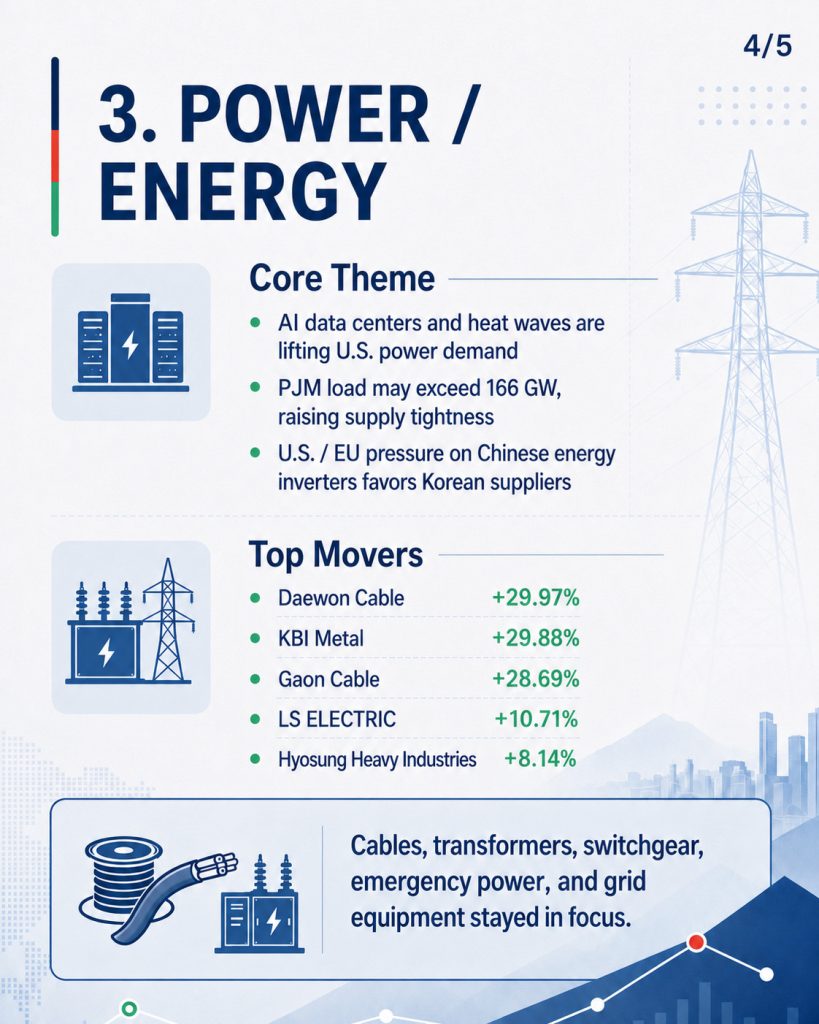
Power and energy names were another clear leadership group. Daewon Cable rose 29.97%, KBI Metal gained 29.88%, Gaon Cable climbed 28.69%, LS ELECTRIC advanced 10.71%, and Hyosung Heavy Industries rose 8.14%. The logic is straightforward: AI data centers need enormous electricity, while heat waves are increasing peak power demand. This combination keeps cables, transformers, switchgear, emergency power systems, and grid equipment in the spotlight.
The International Energy Agency expects global data-center electricity consumption to more than double to around 945 TWh by 2030, which supports the long-term case for power infrastructure investment. Meanwhile, PJM-related power demand concerns in the U.S. reinforced the idea that electricity supply tightness is becoming an investable AI theme, not just a utility-sector headline. :contentReference[oaicite:1]{index=1}
Special Situation Stocks
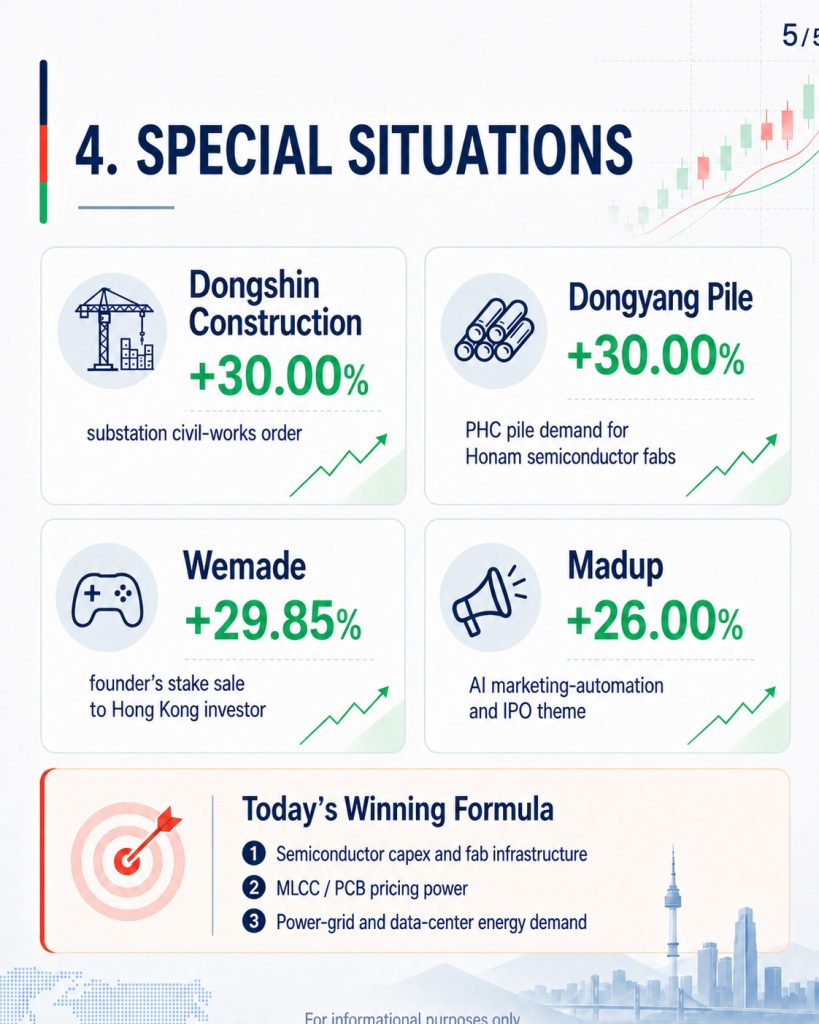
Several individual names moved on company-specific catalysts. Dongshin Construction hit the upper limit with a 30.00% gain after a substation civil-works order. Dongyang Pile also rose 30.00% on PHC pile demand expectations related to Honam semiconductor fab construction. Wemade jumped 29.85% after news of a founder stake sale to a Hong Kong investor, while Madup gained 26.00% on its AI marketing automation and IPO theme.
Investor Takeaway
Today’s market was not kind to the KOSPI headline, but the underlying rotation was highly instructive. The winning formula was semiconductor capex, fab infrastructure, MLCC and PCB pricing power, and power-grid demand linked to AI data centers. For investors, the next step is to separate short-term momentum from companies with real order visibility, capacity expansion, pricing power, and earnings leverage. The AI trade is no longer just about chips; it is about everything required to build, power, cool, connect, and scale the AI economy.