 Korean Stock Insight
KOSPI Reverses a 3.55% Intraday Drop: Chip Buybacks Lift the August 31 Close
South Korea’s stock market delivered one of its sharpest intraday reversals of 2026 on August 31. The KOSPI finished 31.14 points, or 0.46%, higher at 6,820.02. That close hides the stress earlier in the session: the index opened at 6,613.58 and fell as low as 6,547.76, a 3.55% decline, before erasing the entire loss and turning positive late in the day.
The main lesson is that the headline index and the underlying market told different stories. The KOSDAQ fell 4.12 points, or 0.49%, to 834.29 after touching 805.14 intraday. The recovery was therefore concentrated rather than a full restoration of risk appetite.
Why the KOSPI Rose Despite Broad Selling
Foreign investors sold a net KRW 639.9 billion of KOSPI shares. Institutions sold KRW 793.1 billion and retail investors sold KRW 144.3 billion. With all three major groups net sellers, the decisive flow came from the other-corporations category, which bought roughly KRW 1.57 trillion. Market reports widely linked that buying to share-repurchase programs at Samsung Electronics and SK hynix.
Samsung Electronics recovered from an intraday low of KRW 246,000 to finish at KRW 260,000, up 1.17%. SK hynix rebounded from KRW 1,577,000 to KRW 1,674,000, a gain of 1.27%. Given their large index weights, recoveries in those two stocks were powerful enough to pull the KOSPI back above its previous close. Samsung Electro-Mechanics added 2.60%, showing a limited extension of the recovery into large-cap IT components.
What Triggered the Morning Selloff
The early decline followed hawkish monetary-policy signals from Jackson Hole, renewed concern about higher U.S. rates and a 3.47% fall in the U.S. semiconductor index. USD/KRW rose KRW 3.9 to 1,368.6. For a Korean market with heavy exposure to semiconductors and other long-duration growth assets, rising yields and a weaker won can simultaneously increase valuation pressure and undermine foreign flows.
Those macro pressures eased later in the session. Optimism around Nvidia and Korean exports improved, while concentrated corporate buying accelerated the recovery in the two memory-chip leaders. However, the closing flow data still argue for caution: foreign and institutional investors did not confirm the rebound with net purchases.
Selective Strength in Batteries, Robotics and PCB
The KOSDAQ’s internal flows remained defensive. Retail investors bought a net KRW 253.5 billion, while foreign and institutional investors sold KRW 54.3 billion and KRW 201.5 billion, respectively. Even so, a few growth segments showed relative strength. EcoPro BM gained 2.20%, EcoPro rose 1.22%, and KOSPI-listed LG Energy Solution advanced 2.16%. This looked like selective buying in oversold battery names rather than a broad growth-stock rally.
Robotis climbed 6.40% to KRW 257,500 and SIMMTECH gained 5.29%. Both moves reflected interest in stock-specific growth catalysts—robotics and semiconductor substrates—despite weak index breadth. Biotech told the opposite story: PharmaResearch fell 7.69%, ABL Bio lost 5.46% and Alteogen declined 3.91%. Those losses help explain why the KOSDAQ could not follow the KOSPI into positive territory.
Four Signals for the September 1 Session
- August exports: Strong semiconductor export data would provide a fundamental bridge from buyback-supported prices to earnings expectations.
- Buyback persistence: Samsung Electronics and SK hynix need to hold their gains when other-corporate buying normalizes.
- Foreign flows and FX: Another rise in U.S. Treasury yields or USD/KRW could keep foreign investors on the sell side.
- Market breadth: Stabilization in KOSDAQ biotech and broader participation beyond batteries, robotics and PCB would improve the quality of the rebound.
The August 31 close was impressive, but the identity of the buyer mattered more than the final index level. Corporate repurchases created a short-term floor under the KOSPI. A more durable advance will require improving foreign and institutional flows, a stable currency and confirmation from the KOSDAQ.
Related KSI Research
- KOSPI Crash on August 19: How U.S. and Japanese Bond Yields Hit Korean Stocks
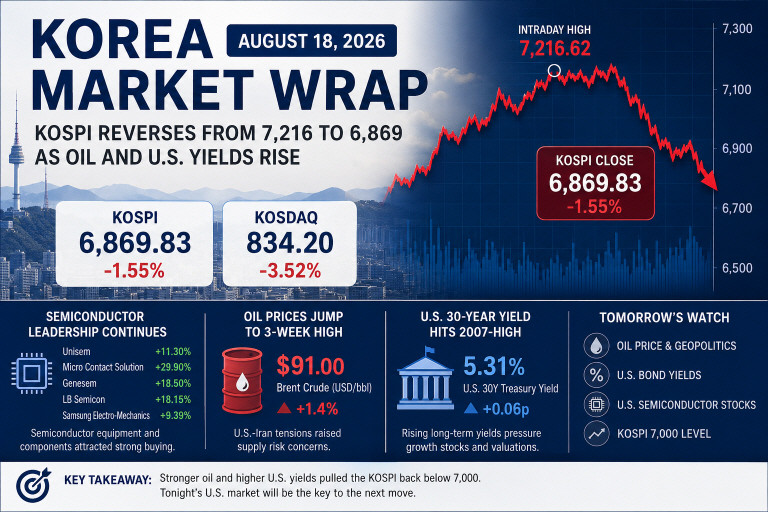
- KOSPI Close on August 18: Why 7,216 Turned Into a 6,869 Finish