 Korean Stock Insight
KOSPI Crash on August 19: How U.S. and Japanese Bond Yields Hit Korean Stocks
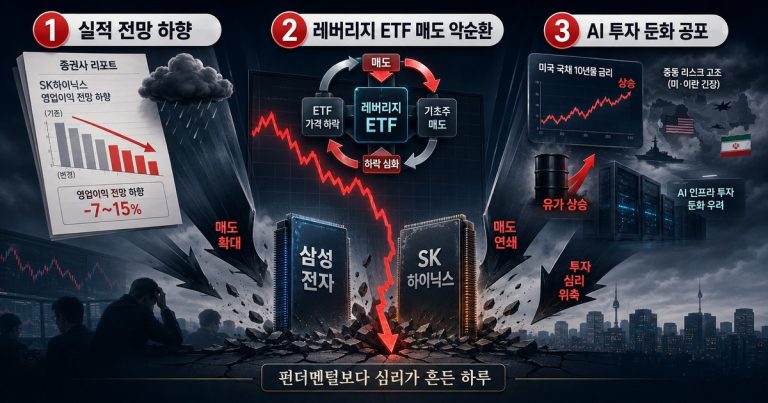
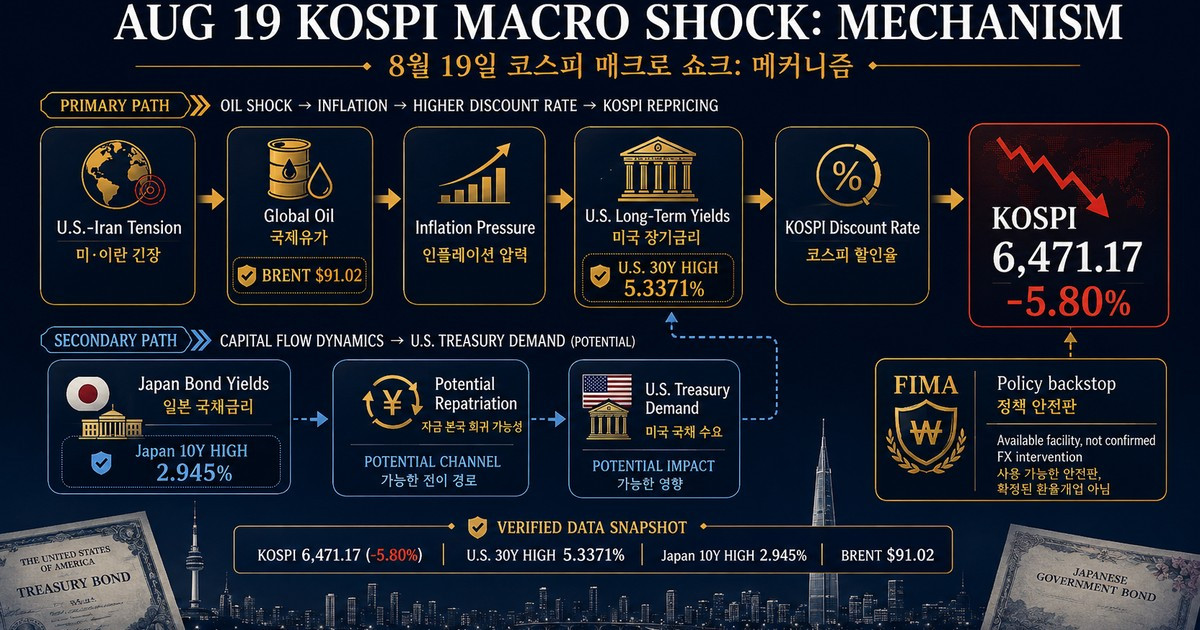
The KOSPI crash on August 19 was difficult to explain through company-specific news alone. The index closed at 6,471.17, down 5.80%. AI investment and high-bandwidth-memory demand did not disappear in one session. What changed was the discount rate applied to future earnings as oil prices and global long-term yields rose together. The U.S. 30-year Treasury yield reached an intraday high of 5.3371% during the week, while the 10-year yield touched 4.7478%. Strong earnings can support a business, but they cannot fully protect its share price when the benchmark cost of capital moves sharply higher.
The KOSPI crash was a discount-rate shock
The 6,471.17 close and 5.80% decline appear in Korea Exchange market data, but those figures describe the outcome, not the cause. When a long U.S. government bond offers more than 5%, investors demand more compensation for owning volatile growth stocks. Companies whose expected cash flows lie far in the future are especially sensitive. A semiconductor business can keep a solid profit forecast and still fall if the required return rises. The KOSPI crash therefore looked more like a repricing of global capital than a sudden collapse in Korean fundamentals.
How oil pressure reached the U.S. 30-year Treasury
The first link was renewed concern about the U.S.-Iran conflict and shipping through the Strait of Hormuz. Brent crude closed at $91.02 per barrel on August 18. Investors began treating the geopolitical story as an inflation input rather than a temporary headline. The chain runs from supply disruption fears to higher oil, higher inflation expectations, bond selling, rising long yields and lower equity valuations.
For the KOSPI crash, the 30-year Treasury mattered because it influences long-duration financing and the value of earnings many years ahead. A 5.3371% intraday yield raises the cost of AI data-center investment and reduces the present value of future returns. Reuters global market coverage has highlighted Middle East tension and elevated yields as constraints on risk assets. Intraday figures change quickly, so current prices should always be checked again.
Why Japan’s 10-year yield matters to Wall Street
The United States is only half of the bond-market story. Japan’s 10-year government bond yield reached 2.945% intraday on August 18, bringing 3% within sight. For decades, Japanese insurers, banks and pension funds moved capital abroad in search of returns unavailable at home. As Japanese government bonds become more attractive, the relative benefit of holding foreign debt after currency-hedging costs declines.
Repatriation is not automatic because institutions have different hedge ratios, regulations and maturity schedules. Still, rapidly rising Japanese yields could weaken structural demand for U.S. Treasuries and push U.S. long rates higher. That transmission raises the discount rate applied to Korean growth stocks and was part of the risk behind the KOSPI crash. Japan’s 10-year yield has become a global equity variable, not merely a domestic statistic.
The yen defense and Treasury-selling risk
USD/JPY rose as high as 163.99 in late July before joint U.S.-Japan yen buying helped strengthen the currency toward 155. The intervention interrupted a one-way depreciation trade, but it did not remove the underlying rate and fiscal pressures. In a conventional intervention, Japan sells dollar assets and buys yen. If readily available dollar cash is insufficient, the market may worry that U.S. Treasury holdings could be sold to raise funds.
U.S. Treasury TIC data show that Japan held $1.1431 trillion of Treasuries in May 2026 and $1.1167 trillion in June, remaining the largest foreign holder. Yen weakness could therefore lead to intervention needs, Treasury sales, higher U.S. yields and weaker equities. That is a risk scenario, not proof that Japan financed the latest intervention through a particular Treasury sale. Official transaction disclosure is needed before turning the mechanism into a statement of fact.
What the FIMA Repo Facility can and cannot do
This is where the Federal Reserve’s FIMA Repo Facility matters. Approved foreign official institutions can pledge U.S. Treasury securities to the Fed and obtain dollars instead of selling those securities into the open market. The Fed describes FIMA as an alternative source of dollar liquidity to outright Treasury sales. It can reduce the risk that emergency dollar needs amplify stress in the benchmark bond market.
According to the Federal Reserve’s FIMA FAQ, transactions can be overnight or for seven calendar days, require eligible Treasury collateral and remain subject to Fed approval. FIMA supplies dollars; it is not a yen-purchase program. Whether Japan would use borrowed dollars for intervention is a separate policy decision that needs official confirmation. This distinction matters when interpreting the policy response to the KOSPI crash.
Treasury buybacks are not quantitative easing
On August 19, the U.S. Treasury announced that it would at least double liquidity-support buybacks in the 10-to-20-year and 20-to-30-year sectors. The maximum amount per operation is set to rise from $2 billion to at least $4 billion for the announced period. The purpose is to improve market functioning and debt management in less-liquid older securities.
A Treasury buyback is not Federal Reserve quantitative easing. The Treasury operation is part of debt management and occurs alongside government borrowing. QE is a monetary-policy action in which the Fed purchases large amounts of longer-term assets to ease financial conditions. A rate cut is different again: lowering overnight rates does not guarantee that the 30-year yield will fall while deficits, Treasury supply and oil-driven inflation concerns remain high. QE would be a last-resort scenario after severe market dysfunction, not a policy that has already been announced.
The dollar swap line is another firewall
The Federal Reserve and Bank of Japan also maintain a standing U.S. dollar liquidity swap line. It supplies dollars through foreign central banks during funding stress. Unlike FIMA, which lends against Treasury collateral, the swap line exchanges currencies between central banks. Neither facility directly buys yen, but both can reduce a scramble for dollars and forced asset sales.
Joint currency intervention can also discourage aggressive short-yen positions, although lasting stability depends on the U.S.-Japan rate gap, inflation and fiscal credibility. Gradual Bank of Japan tightening may support the yen, while excessively rapid increases in long JGB yields could encourage repatriation. Policy makers must therefore balance currency stability against orderly bond-market adjustment.
Four scenarios after the KOSPI crash
| Scenario | Possible market or policy path | Interpretation |
|---|---|---|
| Best | U.S.-Iran tension eases and oil declines | Inflation fears and long yields stabilize naturally |
| Base | Joint intervention, possible FIMA use and gradual BOJ normalization | Pressure from yen weakness and Treasury selling is contained |
| Stress | Larger Treasury buybacks, rate cuts and measures to stabilize JGB trading | A policy mix limits worsening financial conditions |
| Crisis | Direct Fed purchases considered after severe Treasury-market dysfunction | QE is a final backstop with significant inflation tradeoffs |
This table is an analytical framework, not a prediction. After the KOSPI crash, investors should monitor the U.S. 30-year yield, Japan’s 10-year yield, USD/JPY, Brent crude and foreign cash-equity flows. Lower yield highs, stable oil and an orderly yen would reduce the risk premium. If oil and both long yields keep rising, global discount rates will matter more than a technical KOSPI support level.
Conclusion: three macro numbers matter most
The KOSPI crash demonstrated that good companies are not immune to a global macro shock. AI infrastructure spending and HBM demand did not disappear overnight. Yet when the U.S. 30-year yield exceeds 5%, Japan’s 10-year yield approaches 3% and oil rises above $90, investors apply a higher discount rate to future profits. Even companies with firm earnings can be sold during that adjustment.
The first numbers to watch are therefore not only KOSPI support levels. They are the U.S. 30-year Treasury yield, the Japanese 10-year government bond yield and USD/JPY, with Brent crude as the inflation trigger. If those indicators turn, corporate earnings can return to the center of the market narrative. Until then, the lesson of the KOSPI crash is straightforward: check the price of long-term capital before relying on the strength of an individual stock.
This article is for informational purposes only and does not constitute investment advice. Investment decisions and their consequences remain the responsibility of the investor. Verify the latest disclosures and market information before making any investment decision.